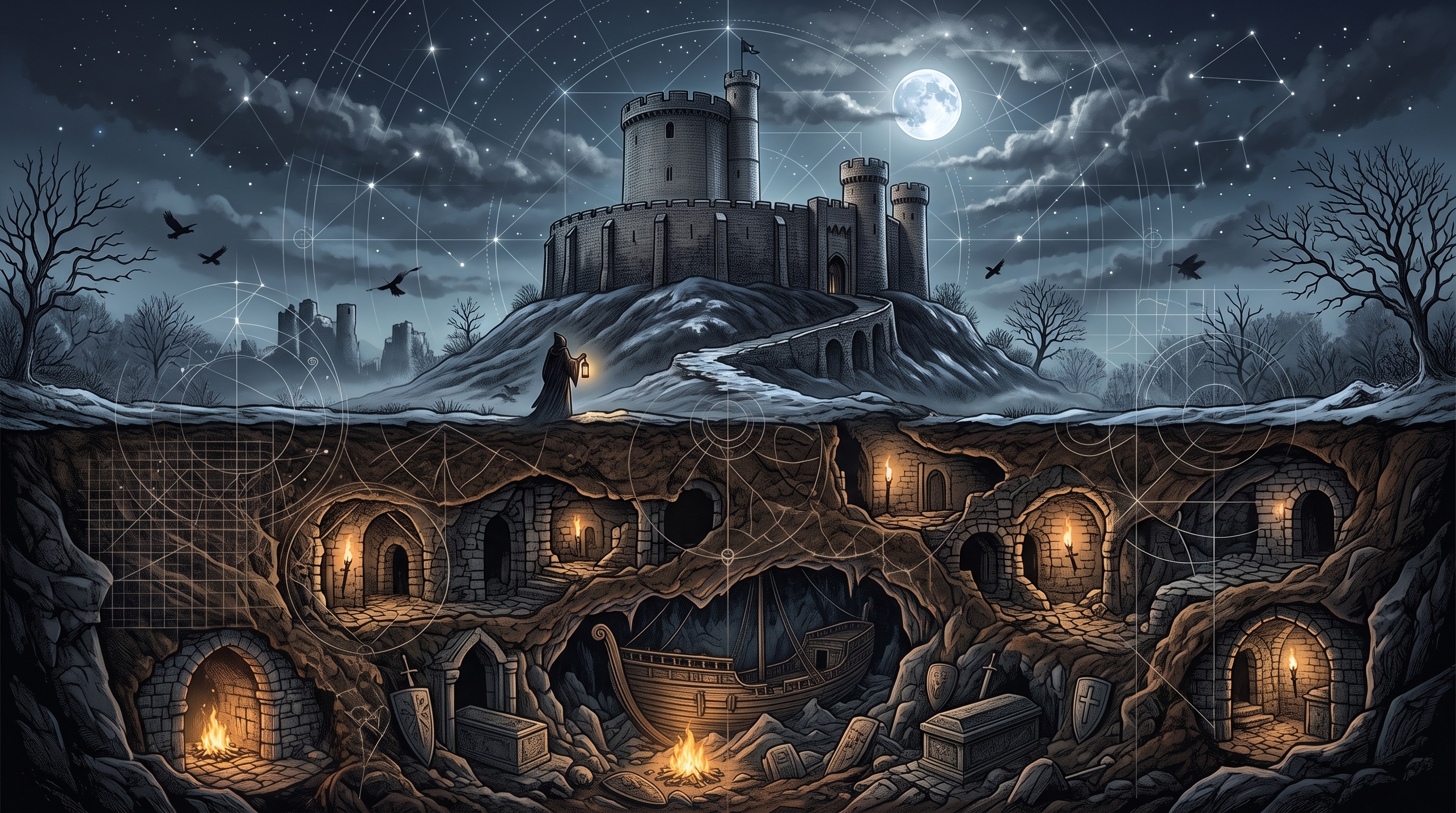
Gemini Analysis of “Gisors et son secret...”
16 September 2026
Here is a structured English translation and transcript of the primary text from the provided document, “Gisors et son secret…” (Gisors and its secret) by Pierre Plantard. Due to the document's length and its heavy use of esoteric diagrams and genealogical charts, this transcript focuses on the main written narrative: a foreword followed by seven questions and answers.
Title and Introduction
Title: “Gisors et son secret...” by Pierre Plantard, published in Paris by Orbis in 1961.
Foreword: The author suggests that if the castle of Gisors holds a secret, the “science of decipherment” can act as Ariadne's thread to lead seekers from the darkness of a hermetic labyrinth into the light.
Context: The text is structured around seven questions posed to the author by the journalist Gérard de Sède in June 1960.
Geographical and Historical Context
Question 1: The first question asks if Gisors occupies a particular geographical position from a hermetic perspective. The author answers that “hermetic France” is shaped like a hexagonal crystal with Bourges at its center, and Gisors forms a significant triangle with Jarnac and Montrevel.
Question 2: When asked what form the enigma of Gisors takes, the text explains that medieval initiates expressed themselves through complex symbols and that the secret is hidden in the “mute language” of the cut stones of the fortress.
Question 3: The third question asks who built the fortress on these secret foundations. The author attributes it to brotherhoods of stonecutters and architects, linking them to the Benedictines and the Knights Templar. The text specifically notes the “cutting of the elm” in 1188 as the moment a secret order known as “ORMUS” or the Priory of Sion (Prieuré de Sion) was established.
Hermetic and Astronomical Plans
Question 4: Asked if the fortress was established on a hermetic plan, the author confirms this, comparing the architecture to a celestial map linking the macrocosm and microcosm. He references three sacred chariots in the stars: David's Chariot (Ursa Major), the Little Chariot (Ursa Minor), and the Chariot of the Seas (Argo Navis).
Question 5: The text questions if this alchemical work was only realizable during specific periods. Plantard responds that the ideal moment was midnight on December 24th, tying it to the winter solstice, ancient solar cults, and the precession of the equinoxes.
Question 6: When asked about a hermetic “signature” in the building, the author describes the “Seal of the Ark”. He claims the architecture relies on magic squares –specifically citing the “SATOR ROTAS” square – and a mathematical “cube of 7” which determines the hidden entrance and underground layout.
Symbolism and Conclusions
Question 7: The final question asks if there are symbolic clues in the church or castle to guide a pilgrim. The response points to the Church of St-Gervais and St-Protais, highlighting an inscription near a marble corpse that reads “O MATER DEI, MEMENTO MEI” with the date 1526. It also directs the seeker to the “Prisoner's Tower”.
Conclusions: The document concludes that Gisors does possess a lost secret. Plantard asserts that the Templars left their mark in the geometry of the keep and the chapel of St. Thomas, and that the treasure can theoretically be discovered by one who deciphers the architectural grid and the legend of the prisoner, Nicolas Poulain.
|