Easter Sunday 2026 – A Time To Reflect
5 April 2026
Updated 9 April 2026
The Protestant Reformation only began on 31 October 1517, when Martin Luther published his Ninety-five Theses in Wittenberg, Germany. That is, during the 16th Century. This course of action opened the door for the spreading of Christianity into becoming a vast number of conflicting and varied multiple sects throughout the World. Martin Luther was physically protected from the forces of the Holy Roman Emperor Charles V and the Vatican by the army and security forces of Frederick III the Wise, Elector of Saxony.
The Church of England, although “officially” part of this historical process, really originated when the Vatican, under Pope Clement VII, consistently refused to annul Henry VIII’s marriage to Catherine of Aragon between 1527 and 1533, preventing him from legally marrying Anne Boleyn. A formal threat of excommunication for marrying Anne Boleyn was issued on 5 January 1531, by the Pope, marking a firm refusal.
King Henry VIII, although splitting from the Vatican and its Roman Catholicism (King Henry VIII's Act of Supremacy, that also made the Monarch the Head of the Church of England, in 1534),
nevertheless continued to accept Roman Catholic beliefs and tenets as marked in his “Book of Common Prayer”. The first official “Book of Common Prayer”, which defined the Church of England's worship, was not published until 1549, during the reign of Henry VIII's son, Edward VI. While drafted under Henry VIII, the first English-language service authorized in his reign was the Exhortation and Litany in 1544 (King Henry VIII died in 1547). The Book of Common Prayer preserved essential Catholic elements in a moderated, vernacular English form.
Protestantism is popularly described as challenging the Roman Catholic Church's practice of selling indulgences – but it is also equally notable for rejecting the perpetual Virginity of Mary the Mother of Jesus Christ, opening the door for priests to marry and eventually allowing women in to becoming priests, a major blunder as found within in the original Christian Religion, since this went against the very reason for the existence of Christianity. The very origin of anti-Semitism lies in the Christian acceptance of what was to become known as “Original Sin”.
The former monk, Martin Luther, married the former nun Katharina von Bora, on 13 June 1525. Three of his colleagues married before him – Philipp Melanchthon, a theologian in 1520, Johannes Bugenhagen, another theologian in 1523 and Ulrich Zwingli the pastor in 1524.
Anne Zernike (1887-1972) was ordained as a pastor by the Mennonite Church in the Netherlands on 5 November 1911, thus becoming the first female minister in the Netherlands and Europe (her spouse was Jan Mankes). Angela Berners-Wilson (born 1954) was the first woman to be ordained as a priest in the Church of England on 12 March 1994, at Bristol Cathedral (her spouse is Andrew Sillett). The first female British Archbishop of Canterbury was Dame Sarah Mullally, ordained on 25 March 2026, becoming the 106th person to lead the Church of England and the Anglican Communion (her spouse is Eamonn Mullally).
It was far too difficult for Martin Luther to understand that the Perpetual Virginity of Mary the Mother of Jesus – that originated during second-Century Christianity – was also the origin of the “Incarnation”. In other words, religious beliefs personified [the attribution of a personal nature or human characteristics to something non-human, or the representation of an abstract quality in human form]. The Perpetual Virginity of Mary was a development of ideas and beliefs found within the Letters of Paul that led to the doctrine of “Original Sin” (Augustine of Hippo was the first to coin, shape and use the Latin term “peccatum originale” in the late 4th to early 5th century). The Divine Presence of Jesus Christ in the Eucharist DOES originate from the first century in the Letters of Paul (1 Corinthians 10:16), thus representing Christian dogma from the earliest period. Protestantism fails to understand BASIC Christian chronology.
What the Protestant religion is doing is what is commonly called “having its cake and eating it”.
According to the “World Christian Encyclopedia: A Comparative Survey of Churches and Religions In The Modern World” of 2001 by David B. Barrett, George Thomas Kurian and Todd M. Johnson (Two Volumes), “World Christianity consists of 6 major ecclesiastico-cultural blocs, divided into 300 major ecclesiastical traditions, composed of over 33,000 distinct denominations in 238 countries” (page 16).
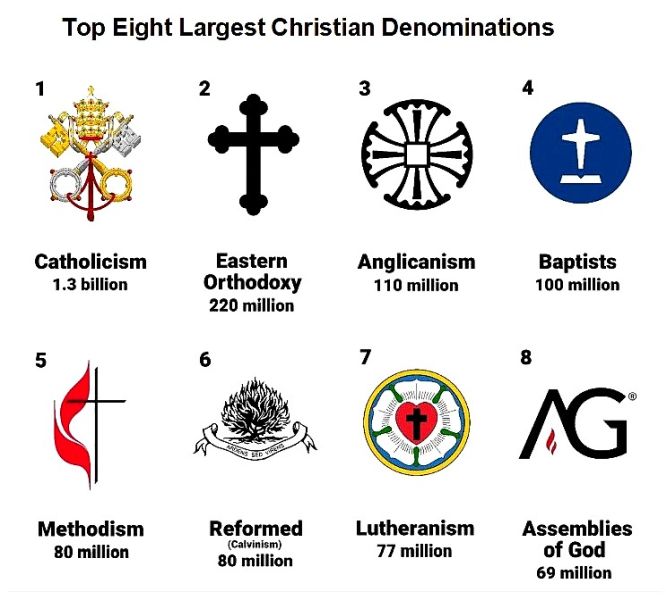
A more accurate figure of today estimates 45,000 distinct Christian denominations and sects worldwide, according to estimations from the Gordon-Conwell Theological Seminary. While Christianity is broadly divided into six main traditions — Catholicism, Protestantism, Eastern Orthodoxy, Oriental Orthodoxy, Anglicanism, and Restorationism — the vast majority of denominations (of course) exist within Protestantism.
What really marks the rise in females becoming priests within Protestantism is really the rejection in the world as a whole of Christianity. Christianity is regarded as becoming more and more of an anachronism – no matter how much the Church tries to recruit young people since the 1970s into things like Discotheques and other associated trends!
Gene Robinson was the first openly gay Bishop of New Hampshire, America on 2 November 2003; of the American Episcopal Church, part of the Anglican Communion. Robinson was previously married to a woman (Isabella Martin) from 1972 to 1986, with whom he had two children, and came out as gay after his divorce. He later entered a long-term relationship with Mark Andrew. His election and consecration were highly controversial, leading to significant debate within the worldwide Anglican Communion and causing some conservative American parishes to break away from the Episcopal Church. More recently in 2025, The Most Reverend Cherry Elizabeth Vann was elected as the first openly gay Archbishop in the Anglican Communion (Church in Wales). Her partner is Wendy Diamond.
The sexuality of the members within Protestantism is well known, and this trend is shared within Roman Catholicism. Father Robert Carter, SJ, a Jesuit priest and professor, was recognized as one of the first Roman Catholic priests to publicly come out as gay, doing so in the early 1970s (he died in 2010). He was a prominent LGBT activist, co-founding the National Gay and Lesbian Task Force and Dignity/New York in the 1970s, pioneering advocacy for gay Catholics. Other Roman Catholic priests coming out as gay have been John J. McNeill (Jesuit), Jose Mantero (the first openly gay Spanish priest) and Bernard Lynch, who became the first Catholic priest in the world to enter a civil partnership, doing so in 2006.
Clerical Celibacy within the Roman Catholic Church was a precondition, while it is not unusual for a number of Popes to have broken this rule. If there isn’t “any hope” for heterosexuals then there isn’t any hope for homosexuals or lesbians!
While the condition for becoming an Eastern Catholic bishop is to be unmarried or a widower – individuals with same-sex attraction exist within the Eastern Catholic Churches, as they do throughout the universal Church. However, Eastern Catholic Churches generally adhere to traditional doctrines, viewing homosexual acts as sinful, and they have resisted recent moves to bless same-sex unions. Eastern Catholic Churches, part of the Catholic communion, maintain that marriage is strictly between a man and a woman. The Ukrainian Greek Catholic Church, the largest Eastern Catholic Church, explicitly stated that Pope Francis's 2024 guidance regarding the blessings of same-sex individuals did not apply to them, holding a stricter traditional position. While Eastern Churches allow married men to be ordained, LGBTQ+ individuals with deep-seated tendencies are generally prohibited from being ordained, in line with wider Catholic teaching. In some areas, such as the Middle East, Coptic Catholics and other Eastern Catholics have reaffirmed their opposition to same-sex blessings.
The previous Pope Francis reiterated to CBS News in May 2024 that “homosexuality is not a crime” but a human fact, while confirming again that blessings are for individuals who are part of the Church and not for “same-sex unions”. We have come a long way since the book by William E. Phipps entitled “Was Jesus Married? The Distortion of Sexuality in the Christian Tradition” (Harper & Row, 1970)!
The “Incarnation of Jesus Christ” was merely an echo and a personification of Christian Beliefs. It was not “History” but rather Christian Faith and another Christian Miracle. The Four Gospels had to be created because there simply wasn't enough material in First-Century Christian Literature to form a New Testament for Christianity – that itself was strongly influenced by the Vision of Ezekiel (1:4-28).
|