|
18 April 2026 Historians Point to These 13 Compelling Reasons That Suggest Jesus Was A Real Historical Figure
* The “Non-Christian evidence” is highly dubious and questionable to say the very least. The fragments of Cornelius Tacitus mentioning the crucifixion of Jesus is wrong when it describes Pontius Pilate as a “Procurator” – he was a Prefect. Also, the early church historian Eusebius of Caesarea never mentioned the account accredited to Cornelius Tacitus in his “Ecclesiastical History”. Jewish Accounts An external source that fits other descriptions of Jesus is a mention by Jewish historian Josephus. Although there are some passages that scholars disagree about, most of them concur that at least part of his work proves that Jesus was a real person. * All the Jewish references to Jesus are dated from the second century and the earliest fragments of Flavius Josephus are a 3rd-century papyrus fragment of The Jewish War (Vienna, G 29810) and several 9th-century Latin manuscripts, though the vast majority of complete Greek manuscripts date from the 10th-11th centuries. It should be mentioned that the Christian references found in the works of Josephus are often suspected to be Christian forgeries. Texts by Josephus known as the Ethiopic-Josephus and Slavonic-Josephus are completely untrustworthy and full of Christian forgeries. Early Writings The documents of the New Testament were composed comparatively soon after the life of Jesus, which is not typical of ancient history. This closeness minimizes the possibility of myth substituting memory and indicates that the narratives were founded on actual occurrences. * It cannot be said that the earliest known examples of the Gospels are from the first century. The first century Christian writings do not mention the historical Jesus at all (eg, no references to Virgin Mary, Mary Magdalene, John the Baptist, Pontius Pilate, etc). Consistent Narrative In the various texts, the main account of Jesus is very similar, not only in terms of his being a teacher but also in his death. This consistency lends credence to the notion that these accounts give a common historical reality as opposed to fancied stories. * Crucifixion of the Jews was practiced since Judea was first invaded by the Greek Seleucid Kings and later continued by the Romans. The Crucifixion of Jesus in the earliest First Century texts is a marked difference to the Crucifixion of Jesus in the Gospels of the Second Century. Named Figures The documents of Jesus contain records of actual historical events such as Pontius Pilate and Herod who are verified by other manuscripts. This is based on a familiar history which lends credibility to the narratives where Jesus is featured. * The documents of Jesus that contain names such as Pontius Pilate and Herod are from the Second Century Gospels and not from the Christian texts of the First Century. Geographic Accuracy The accounts of the places, towns, and cultural practices are descriptions that are consistent with what historians know about first-century Judea. Accurate information concerning geography indicates that the authors were conversant with the location and probably relating actual events. * Basic geographic mistakes also occur in the Gospels. For example Dennis Nineham (1921-2016) discovered a basic geographic mistake in the Gospel of Mark that was laughable in nature. Cultural Context The teachings and actions of Jesus were very appropriate in the Jewish culture and religious controversies that existed during his era. Historians observe that his message captures the issues and words of that time which further embeds him in history. * But still nevertheless generated the acts of the Sanhedrin against Jesus during his alleged “historical crucifixion” and generated the birth of anti-Semitism. Execution Record This testimony of sources that Jesus was crucified is a powerful historical landmark. Crucifixion was not an unfamiliar form of punishment in the Roman world, and the information can hardly be fabricated because it is a humiliating and cruel procedure. * Again it has to be repeated that Crucifixion began in Judea with the Greek Seleucid Kings and that the accounts in First Century Christian texts never mention the figure of Pontius Pilate. The Crucifixion of roughly 800 Jews – primarily Pharisees – by the Jewish Maccabean (or Hasmonean) King Alexander Jannaeus around 88-87 BCE was an exceptionally severe and “inhuman” act, often highlighted in historical accounts for its calculated cruelty. Rapid Movement The early spread of Christianity was rapid and it was soon after the life of Jesus that it may well be presumed that people were acting on a response to an actual person. The kind of movements to that scale are often the result of the authority of a real individual and not a mere figment of imagination. * The rapid spread of Christianity was due to the origin of the Gospels during the Second Century. These texts took up a life of their own that the Second Century Christians never imagined. Eyewitness Claims There are some early documents which purport to have been founded on eyewitness testimony or intimate relationships with individuals who knew Jesus. Although historians consider such assertions with critical attention, they contribute to the discourse of history. * The “Eyewitness Claims” only date from the Second Century Gospels. Scholarly Consensus Modern historians of every stripe, whether or not they believe it to be true, concur that Jesus as a historical figure existed. This is an agreed-upon fact and not one of faith, with evidence backing it over the academic disciplines. * This is a fact – every historian believes in the historical Jesus by obliterating modern scepticism as well as obliterating all evidence of early Christian sects that denied the physical substance of Jesus. Lack of Denial Funny enough, early opponents of Christianity did not claim that Jesus was nonexistent but, instead, opposed his teachings or person. The fact that opponents did not deny the existence of this person adds credence to the argument that his existence was universally accepted. * This is a mistaken claim. The Gospels date from the Second Century while the Christian documents dating from the First Century did not state that Jesus existed as a historical person, but was rather a Crucified Saviour God serving as an atoning sacrifice, later resurrected. * The claim by modern historical scholars since the early 20th century that the Gospels date from the First Century can be called a religious dogma. It is a claim advanced by Universal historical scholarship that cannot be proved. If it is a hypothesis then it is a hypothesis written down as a fact. This contention dates from after the time when German 19th century Protestant theologians stated that the Gospels could only be dated with certainty from the mid-second century; also pointing out the distinction between the Jesus of History and the Jesus of Faith. 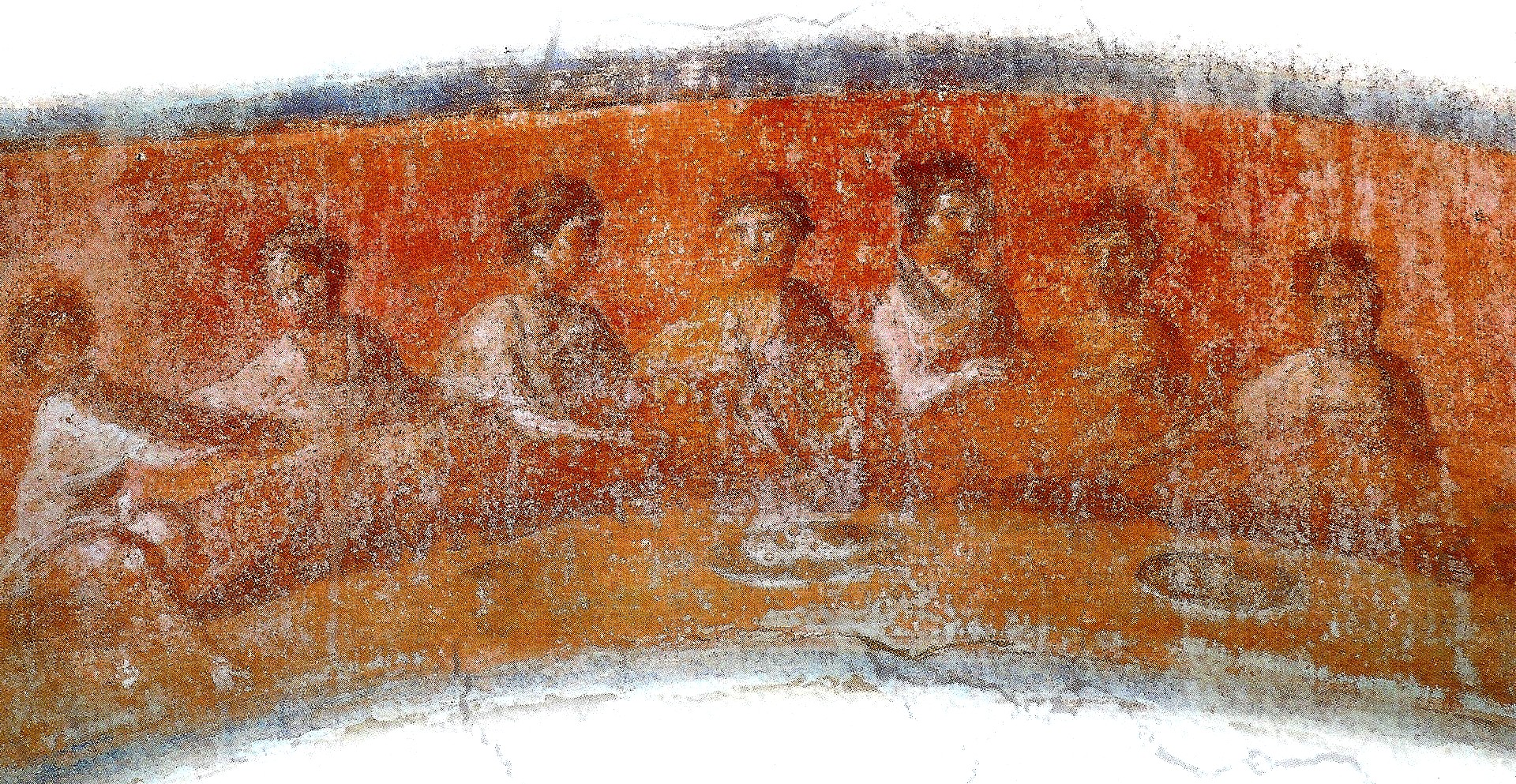
The Fractio Panis (“Breaking of Bread”) fresco, a highly significant early Christian wall painting located in the Greek Chapel (Capella Greca) of the Catacomb of Priscilla on the Via Salaria in Rome. Dating to the first half of the 2nd century (c. 100–150 AD), it is considered one of the oldest visual representations of the Eucharist. |