https://www.msn.com/en-ie/video/peopleandplaces/what-archaeology-says-about-the-facts-of-jesus-tomb/vi-AA1RGPS2?item=flightsprg-tipsubsc-v1a?season//

ReligionForBreakfast

Mark Goodacre, How Empty Was The Tomb? (Journal for the Study of the New Testament, Volume 44, Issue 1, pp. 134-148, September 2021)

What archaeology says about the facts of Jesus' tomb

Most people picture Jesus’ tomb as a small, empty chamber with a single stone bench, but archaeology tells a very different story. First-century tombs around Jerusalem were multi-person family complexes holding many bodies at once. The gospels mention rock-cut chambers and rolling stones – details that match these larger tombs, not the modern artistic version. Early writers even seem anxious to clarify that Jesus was the first body inside, likely to avoid confusion in a crowded tomb. This video breaks down what Jesus’ tomb actually looked like and why it matters.

==============================================

What Archaeology Says About The Facts Of Jesus' Tomb

Presented by Andrew Henry


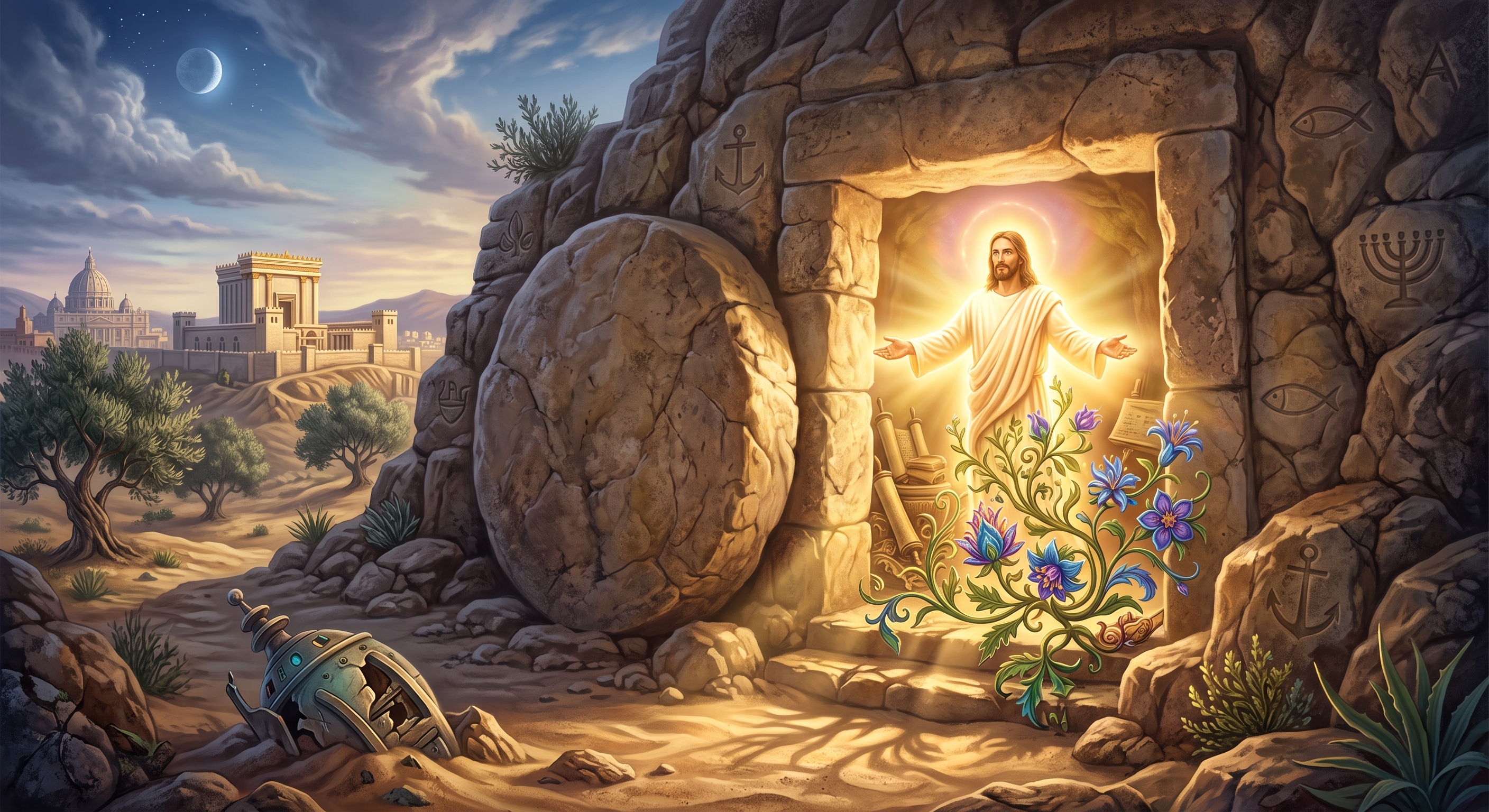
When it comes to contemporary Christian culture, this is what the tomb of Jesus often looks like. It's a small room with a shelf for the body or an open sarcophagus.

But in a 2021 article, the New Testament scholar Doctor Mark Goodacre argues that this image of a single occupancy tomb is almost certainly wrong. In fact, there's a strong likelihood that if Jesus was indeed buried in a tomb, the tomb was not empty at all, but filled with other bodies.

So Doctor Goodacre asks a very fair question: how empty was the tomb? Before we dive in, we first need to ask, was Jesus buried at all? Scholars debate whether or not Jesus had a formal burial and a proper tomb.

Biblical scholars have long noted it was common for executed criminals, especially those of sub elite status such as Jesus, to be thrown in mass pit graves of left for scavengers on the cross when crucified.

This has LED some scholars, such as John Dominic Crossan and Bart Ehrman, to suggest that Jesus is unlikely to have received any formal burial. Others argue that the burial of Jesus as depicted in the Gospels does match with what we know about Jewish practice at the time and is the more likely historical outcome.

Though as I say in another video, even this position is split between scholars that hold the traditional view – that the body ended up in a proper family tomb – and others who argue Jesus probably received a burial – but a dishonorable burial in a tomb reserved for criminals.

In this video, we're not staking a claim in this debate, but rather we're asking the question what sort of tomb do our early sources envision whether or not they're reporting a historical event? What did tombs around Jerusalem look like during the time of Jesus that the Gospel writers had in mind?

Goodacre noted that the common portrayal that we see in Christian art and pop culture is what we might call a single occupancy tomb. But during the 1st century CE, rock cut tombs were always multi person tomb complexes. As Goodacre says, these tombs were generally cut out of the limestone and included multiple niches called loculi to hold the bodies.

This on screen is the so-called Tomb of Anas, located West of the Old City of Jerusalem. Shout out to Zahi Shaked for this footage. You can check out his channel in the description below.

It's thought to be the tomb of the High Priest Anas, the father-in-law of Caiaphas. You may have heard of Caiaphas as the High Priest who played a significant role in the trial and crucifixion of Jesus. It's a fairly fancy tomb and notice it consists of a handful of loculi. Another example is the so-called Tomb of the Kings, which is actually the tomb of Queen Helena of Adiabene, A Parthian vassal state. It features a huge courtyard and a large mikva, or ritual bath for visitors.

Then there's the so-called Sanhedrin Tombs, a group of fancy rock cut tombs with around 70 loculi and also featuring a courtyard where visitors could gather. These design elements, seen at Queen Helena's tomb and the Sanhedra Tombs reflect religious practice during the time of Jesus.

In the ancient Jewish world, burial and honoring the dead was a family affair. Relatives and friends often gathered at the tomb and shared ritualized meals with the departed, particularly during festivals that commemorated the dead. Families would also sometimes conduct processions from the home to the tomb and back again as part of special ceremonies.

So tombs were designed to hold multiple deceased family members and provide space for the living to congregate, thus allowing a site for the living and the dead to ritually reconnect. And the Gospel writers seem to envision this kind of multi person familial tomb complex.

In his article, Doctor Goodacre points out that the Gospel writers specifically mentioned the tomb being hewn out of rock. And as we've just seen, archaeologists have found that rock cut tombs around Jerusalem are always multi person tombs. Moreover, the Gospel stories mentioned that the tomb was sealed with a round stone that you could roll. Although this is commonly thought as a way to secure the tomb – you know – to keep people out. The whole point of a Rolling Stone is to be rolled, providing relatively convenient access for families to return again and again to bury new bodies, visit their deceased relatives, and again to bury new bodies, visit their deceased relatives, and to collect bones and place them into ossuaries, containers that held the bones of the dead. The presence of a Rolling Stone makes the most sense in the context of a multi person tomb that you would visit. Not the idealised one bench tomb as depicted in art. Finally, as Goodacre says, rock cut tombs like this are of course elite tombs. They're used by relatively well off families and all of the early Gospel traditions say that the body of Jesus was taken and buried by a relatively well off man named Joseph of Arimathea. So given the early gospel stories, it seems that they were picturing something more along the lines of a high end family tomb complex that could hold multiple bodies. The kind that the elite of Jerusalem used for their extended family.

If this is what the Gospel writers had in mind, Goodacre argues that a few phrases from the Gospels in which the followers of Jesus enter the tomb suddenly make a little more sense.

For example, in Matthew, the Angel says come and see the place where he lay. This invitation is kind of superfluous if we're talking about a cozy little room with an easily viewable bench – but it does make sense if you're entering a relatively large room with multiple niches for bodies, because that would require pointing out a specific place where he lay. The angels' invitation is less about the divine mystery – Hey, look at this empty bench here – But the practical tomb logistics. Also in Luke and John, characters must stoop down while entering the tomb in order to confirm the body is gone. The implication is it's not a peek inside a cramped room situation, but a full on exploration to confirm the dearly departed has departed.

So if Jesus was buried in a multi person tomb – or at the very least the Gospel writers assumed he was buried in a multi person tomb – then where do we get the tradition that is popular today – that his tomb was empty?

There are hints within the Gospel tradition that early Jesus followers wanted to imply that Jesus was indeed alone in a large tomb that could hold multiple people.

The Gospel of Matthew, for example, says that the tomb was newly cut, implying that the body of Jesus was the tomb's first body. The Gospel of Luke goes even further, saying that Joseph laid Jesus in a rock hewn tomb where no one had ever been laid. Why would Matthew and Luke insist that the tomb was new and vacant? Well, Goodacre thinks that we can detect some anxiety or apologetic agenda under the surface here. If Jesus was buried in a tomb with a bunch of other bodies, a skeptical observer might argue, he didn't rise again – you just lost him in the crowd.

Goodacre goes on to say that the very fact that Matthew and Luke seem so insistent that Jesus was definitely buried in a new tomb where no one else was laid, this only highlights the fact that the Gospel of Mark doesn't mention this at all. Mark says that a young man dressed in white says to Mary Magdalene, look, there is the place they laid him. Perhaps Mark is saying, let's nip this in the bud, here's exactly where we put him. No mix UPS possible. Goodacre concludes: “If multi person tombs are the norm in Jerusalem, and if the Gospels are presupposing the norm, then it could be that Mark's story is a story about Jesus's burial in a tomb in which other corpses are found as well as bones and ossuaries.... And this might explain why Mark is so particular about the precise location of Jesus's body”. And so to head off any corpse confusion, as he says, Matthew and Luke then felt it necessary to take Mark's story and add extra details about the tomb being new.

So, ultimately, do the Gospel writers envision an empty tomb for Jesus?

Our earliest accounts don't provide a consistent answer. The Gospel seemed to agree on the capacity of Jesus's tomb, but not its occupancy. All of the early Gospels seem to presume that Jesus was buried in a familial tomb complex which would have held multiple bodies and ossuaries, but they diverge in specifying its tenants at the time of the burial. The later accounts in Matthew, Luke and John state explicity that Jesus was the first to be buried in the complex, but Mark leaves open the possibility that other corpses or ossuaries were present at the time. Mark's ambiguity on the occupancy of the tomb of Jesus reminds us that the earliest Christian narratives, even once they were written down, were of evolving and fluid. They were responding to the distinctive pressures and challenges that Christians were facing at the time. Christians undoubtedly encountered skepticism about the resurrection of Jesus, and so they adjusted the way they narrated the tomb in response. The ambiguity should also remind us that we shouldn't take empty tomb terminology at face value.

It's very likely that the body of Jesus came to rest alongside other corpses, or at the very least, among other burial niches.

So, as Goodacre points out, when the Angel asks in the Gospel of Luke, why are you looking for the living among the dead? We could offer an even more precise translation of the Greek – Why are you looking for the Living One among dead people?

Now, as I said earlier in the video, there are well respected critical scholars on both sides of the debate about how the body of Jesus was treated: Pit grave or proper tomb. And part of the reason for this debate is because ancient Roman sources that actually describe how the victims were treated cut in both directions. Ironically, our only archaeological evidence for a crucified man was found in a tomb, but we also have a bunch of textual sources that say crucified victims were denied a proper burial.

To work through the evidence of this debate, I'm offering an online class called “Crucifixion and Burial In The Roman Empire”. It will be on Wednesday, March 27th 2024 at 9:00 PM US East Coast Time.

Now, crucifixion is probably the most famous form of execution in the world because it was the method used to execute Jesus – and the Cross, despite it being used as a tool of brutal capital punishment, is now the symbol of the largest religion on earth. Yet despite its widespread fame, the real history and practice of crucifixion is poorly understood. So we'll examine actual Roman sources to answer who was actually targeted for crucifixion and Roman society. We'll examine some common misconceptions and debunk some fringe theories. And of course, we'll work through the question of burial.

You can sign-up for religionforbreakfast.eventbrite.com and you can pay whatever you want starting at $1.00. I don't want cost to get in the way. I know that 9:00 PM might really be an annoying time for a lot of you, especially for those of you outside of the US. I know that religionforbreakfast has a global audience, so I'll be recording the lecture and I'll send the lecture out to everyone who registers, so no worries if you can't make it live. Again, that's March 27th at 9:00 PM East Coast Time. religionforbreakfast.eventbrite.com. Hope to see you there.

SPECIAL THANKS TO OUR PATREON PRODUCERS!
Exec. Producers: A_Wet_Potato, Alexander Tamas
Audra Owens, Hanan Fikri
Producers: Alex, Edward Clifford III, Michael Jinks

PRODUCTION TEAM:
Host: Andrew Henry, PhD
Writer: Travis Proctor, PhD
Managing Editor: Andrew Aghapour, PhD
Video Editor: Lochlan Davis


priory-of-sion.com