Nascent Christianity
A Potted History of Its Origins
25 March 2026
Revised 29 March 2026
The origin of Christianity can ultimately be seen in the invasion and occupation of Judea by successive forces – first by the Babylonians in around 597-538 BCE, then by the Greek Seleucid Kings in 200-142 BCE – and finally by Rome in 63 BCE, that ultimately destroyed Jerusalem and Judea after two Jewish Wars in 66–73CE, first destroyed by the Emperor Titus –
then by the Emperor Hadrian in 132–135CE – who renamed the province to “Syria Palaestina” and Jerusalem to “Aelia Capitolina”. It was not until after the Jewish Holocaust that the Jewish People got their country back in 1947.
The Jewish concept known as the “Son of Man” was ultimately the embryo for the origin of Christianity, as well as the Essene sect who regarded the Occupation of Judea as punishment by God and its ultimate release from foreign powers by the Apocalypse.
The concept of the “Son of Man” was first used in the books of 1Enoch and Daniel, after the invasion by Babylon, and then later evolving under the Greek and Roman Occupations. This also covered the period of the writing of The Dead Sea Scrolls, originally discovered in 1947. Although parts of The Dead Sea Scrolls were first published in 1950, they did not become fully published until the early 2000s. Two extreme opinions dominate the role of the Essenes on Christianity – but one undisputed fact stands out – the two religions did not co-exist – not one Christian document mentions the Essenes. The Essenes played a direct, or indirect part, in its role on nascent Christianity.
We don't ultimately know which book is older – the Book of 1Enoch or Daniel. In Daniel 7:13-14, the “one like a son of man” is a mysterious, divine figure in a vision who approaches the Ancient of Days (God) and is given everlasting authority, glory, and a kingdom over all nations. Quote: “I was watching in the night visions, And behold, One like the Son of Man, Coming with the clouds of heaven! He came to the Ancient of Days, And they brought Him near before Him. Then to Him was given dominion and glory and a kingdom, That all peoples, nations, and languages should serve Him. His dominion is an everlasting dominion, which shall not pass away, And His kingdom the one Which shall not be destroyed”.
The “Book of Parables” within the Book of 1Enoch (or the Ethiopian Book of Enoch), refers to a pre-existent, Messianic, and divine figure who acts as a judge, chosen by God to execute righteousness (references draw from and expand upon the figure in Daniel 7:13-14). He is pre-existent (“hidden before the creation of the world”). While often portrayed as a distinct heavenly figure, in 1Enoch 71:14-17, the text surprisingly identifies Enoch himself as the “Son of Man”.
Jesus calls himself the “Son of Man” many times in the four gospels of Matthew, Mark, Luke and John (use any Bible Concordance).
The Book of Revelation mentions Jesus as the “Son of Man” twice. In Revelation 1:13-18 and Revelation 14:14-16 (Both of these references mirroring Daniel 7:13).
This was when the concept of Sexual Abstinence within Judaism first became a precondition for the Coming Apocalypse, ultimately culminating in the revision and reinterpretation of story of Adam and Eve in the Garden of Eden as found in the Book of Genesis in the Old Testament.
The figure of Jesus Christ was ultimately revealed as a personification of this concept within the earliest Christian documents of the first-century CE – later developing into a figure of flesh-and-blood, which the Church called the “Incarnation” during the second century CE. There wasn't enough in the earliest Christian documents to form a new Canon of Scripture – therefore the concept of Jesus had to be placed into the History of Mankind to make it seem realistic.
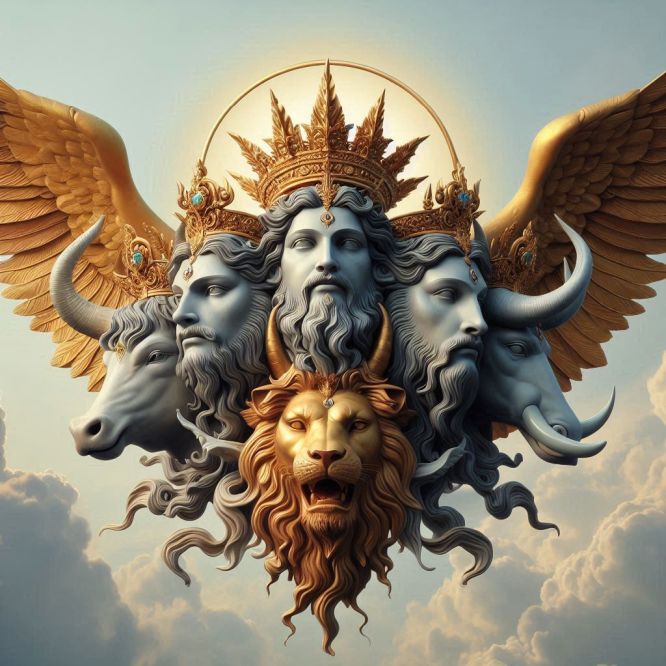
The symbolism of the Vision of Ezekiel, as described in the Book of Ezekiel during the period of the Babylonian Occupation, looks like a far-reaching and over-riding concept within Christianity.
The “Historical Jesus” is an Act of Christian Faith and another “Christian Miracle”. It is not “History” as we understand it today. People may draw their own conclusions about the value of The New Testament and The Holy Bible.
|