Boudet, Adam & Eve, and The Sumerians
30 August 2026
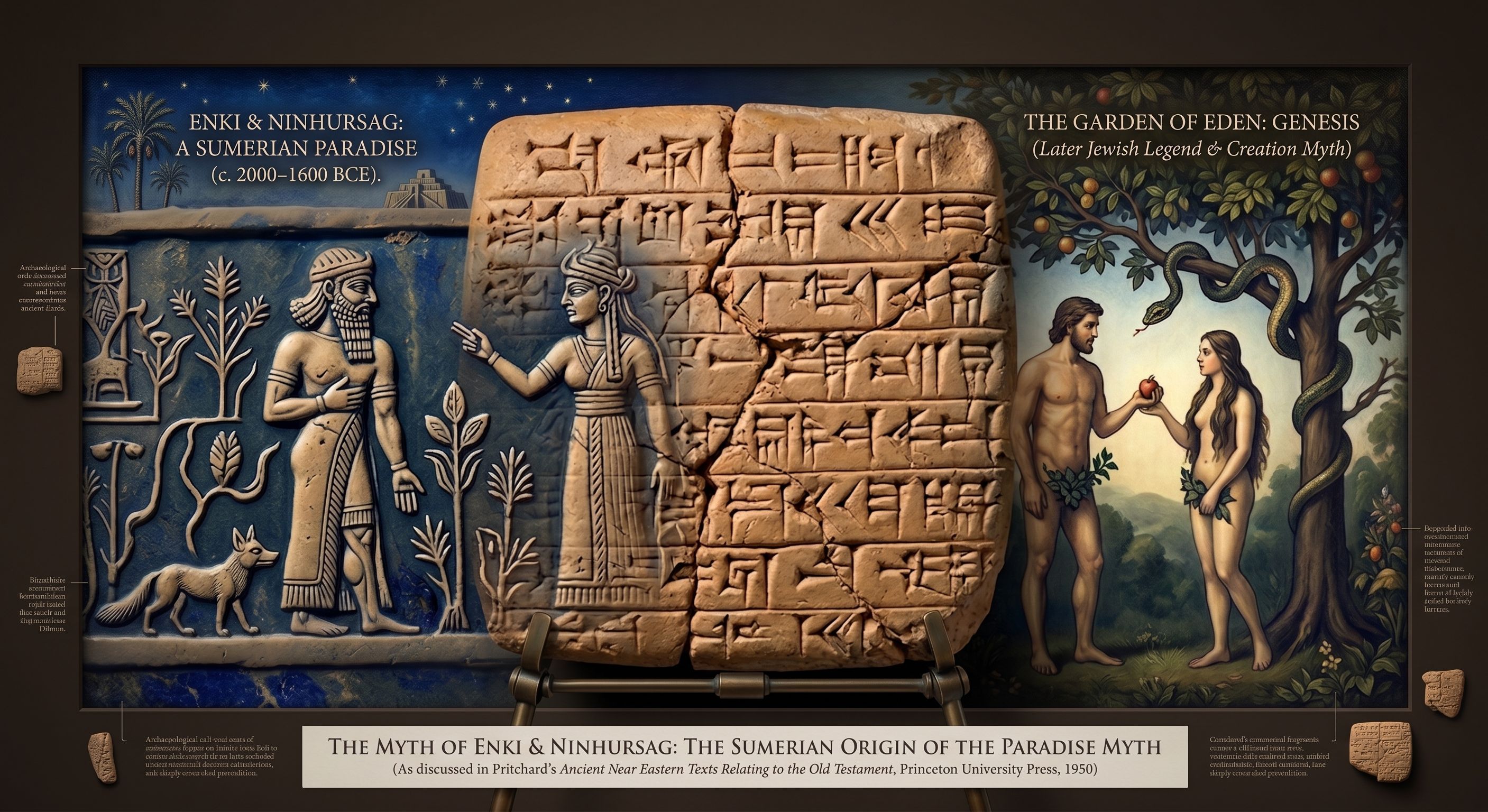
The myth of Enki and Ninhursag was first excavated in the ruins of ancient Nippur during the University of Pennsylvania's archaeological campaigns between 1889 and 1900.
This account states that Enki eats forbidden sacred plants that are grown from his own semen – and falls violently ill, suffering severe pain in his rib. An angered Ninhursag placed a curse of death upon him. Enki is eventually made well again by a sly fox that successfully changes Ninhursag's mind by making him well again.
Since the translations of the Sumerian tablets that include the story of Enki and Ninhursag, early Assyriologists like Samuel Noah Kramer categorized Enki and Ninhursag as a “paradise myth” set in the pristine, uncorrupted land of Dilmun – that corresponds with the Garden of Eden found in the Book of Genesis – and Adam & Eve were modelled upon the myth of Enki and Ninhursag. This later Jewish legend became rebooted and revised into the well-known account and formed part of the Creation Myth found in The Holy Bible, to serve as the Judaic version of events of how Mankind was first created by God.
The myth of Enki and Ninhursag (often titled “Enki and Ninhursag: A Sumerian Paradise”) is preserved primarily on Old Babylonian clay cuneiform tablets dating to roughly 2000–1600 BCE.
The Standard English translation is found in the book edited by James B. Pritchard, “Ancient Near Eastern Texts According To The Old Testament” (Princeton University Press, first published in 1950).
|