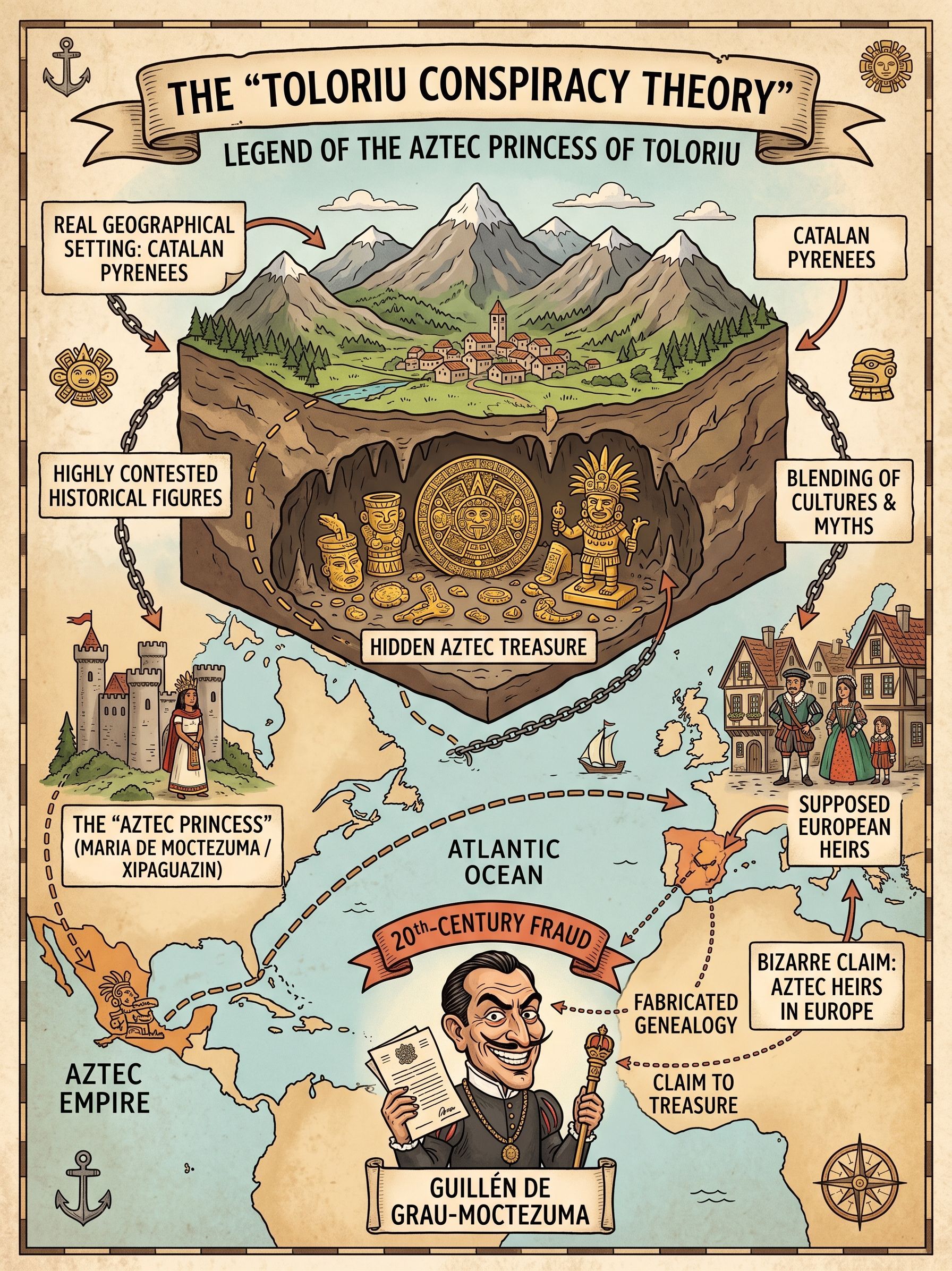
The “Toloriu conspiracy theory” (more commonly known as the “Legend of the Aztec Princess of Toloriu”, named Xipahuatzin) centers on the bizarre claim that a hidden Aztec treasure is buried in the Catalan Pyrenees, and that the rightful heirs to the Aztec Empire live in Europe.
The narrative blends real geographical settings, highly contested historical figures, and 20th-century fraud.
According to historical lore, during the Spanish conquest of Mexico, Xipahuatzin fell in love with one of Cortés's close companions, a Catalan nobleman named Joan de Grau, the Baron of Toloriu. The couple traveled back to Europe together and settled in the fortified Castle of Toloriu in Catalonia. She was baptized with the Christian name María.
Legend states that Xipahuatzin brought a massive imperial Axtec treasure with her from Mexico. Local stories claim that this treasure was hidden somewhere near the castle or inside a nearby rural farmhouse known as “Masia Vima”.
The princess reportedly struggled to adapt to the brutal, freezing winters of the high Pyrenees mountains. She is said to have died of deep sadness and illness in Toloriu on 10 January 1537, taking the secret location of her hidden gold to the grave.
Whilst a local priest named Antoni Soldevila popularised and wrote extensively about her life and the local legends in the mid-1970s, he never found any treasure. The legendary hoard remains completely lost, despite numerous attempts by explorers, looters, and German adventurers over the centuries to dig up the estate.
Today, a commemorative plaque dedicated to her memory stands in the village of Toloriu, and her tragic story has inspired local folklore, books like Imma Tubella's “A cavall del vent” (2019), also told in mockumentaries.