The Tombstone of
Marie de Negri d’Ables, Countess of Blanchefort
Paul Smith
The tombstone of Marie de Negri d’Ables,
the Countess of Blanchefort who died in 1781, the epitaph of
which was used by Philippe de Chérisey during the early 1960s as
a partial template for the creation of his hidden message in his
large "parchment" (another "tombstone" with an additional
"epitaph" had to be created
during the early 1960s with which to form the complete puzzle)
– has never been seen by anybody – except allegedly by
Elie Tisseyre himself in 1905 – who made a "drawing of
the tombstone" in his article entitled Excursion on 25
June 1905 to Rennes-le-Château – first published in the
‘Bulletin de la Société d'Ètudes Scientifiques de
l'Aude’ (Bulletin of the Scientific Research Society of the
Aude, or SESA), volume XVII, 1906 – then for the second time
in a brochure-version of the article published in 1931, that was
deposited in the Municipal Library of Carcassonne.
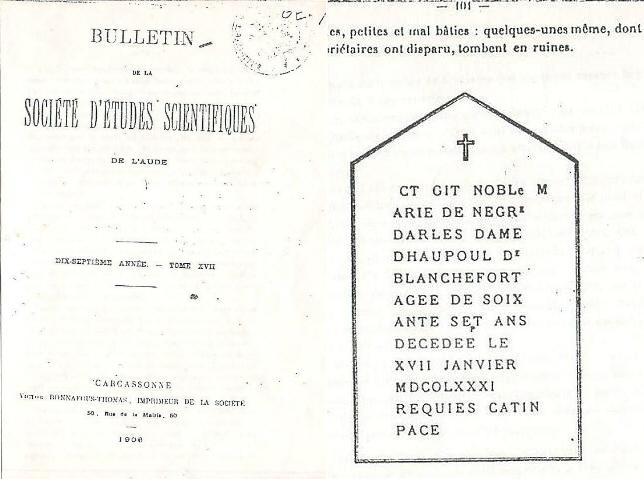
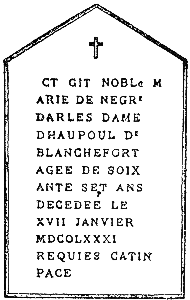
Here is the drawing of the
"tombstone" that appeared in ‘Bulletin de la
Société d'Ètudes Scientifiques de l'Aude’, volume XVII,
1906, page 101:
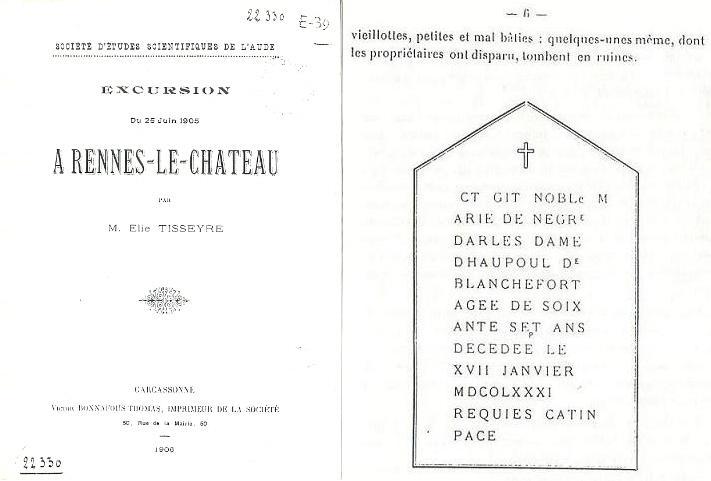
Here is the drawing of the
"tombstone" that appeared in the brochure version of
the article published in 1931, page 6:
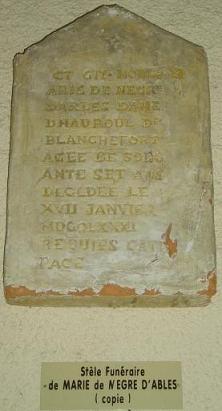
The ‘Saunière Museum’ in the village of Rennes-le-Château holds a couple of ‘replicas’ of the alleged tombstone, but their dimensions differ from what Elie Tisseyre described in his article of the size of the original “tombstone”.
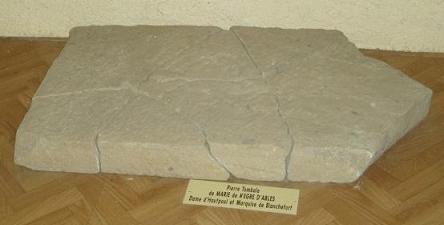
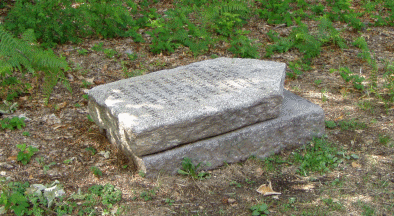
And there are also more ‘replicas’ of the ‘tombstone’ in existence, like the one below:
Here is the complete English translation of
Elie Tisseyre’s article Excursion on 25 June 1905 to
Rennes-le-Château:
EXCURSION ON JUNE 25 1905
TO RENNES-LE-CHATEAU
BY M. ELIE TISSEYRE
The number of excursions to the ruins of Rhedae
or Rennes-le-Château has grown over the years as more and more
visitors come to trace the remains of bygone days.
Consequently the Society for Scientific Study
of the Aude could not fail in its turn to venture thither in
search of a new page of history concerning our region.
Thus on 24 June, the appointed day, a fair
number of fellow-workers squeezed past the station ticket office
to board the train, excitedly clutching their tickets.
At 6.15 the heavy load set off on its route
through station after station. At Alet another colleague, M.
Deville, who was mayor of that fair city, joined us, and a few
minutes later we all arrived at Couiza.
It was going to be a very hot day, so we
descended hastily so as to reach Rennes-le-Château before noon.
Two more colleagues joined us now and we started on our way,
admiring the castle of Couiza on route. It had been constructed
on the banks of the Aude and the Sals in 1540 as the ancestral
home of the Ducs de Joyeuse.
We could already see the pinnacle of the
ancient towers of the castle of Rennes to our right but it took
an hour’s walk to reach the old capital of Rhedesium. At
times followed by and again preceeded by a humble donkey which
carried our bags, we climbed the slope while the botanists
amongst us were already embarked upon their researches.
By 9.30 we had reached the top. It was hot but
at the height of 435 metres the air was fresh enough. Upon our
way we noticed the new fragmentary remains of the encircling
walls or ramparts.
We left our bags in a safe spot and immediately
began our visit to the castle. There was nothing remarkable here
apart from the size of the apartments with their very high
ceilings. Everything was very old, worn and dilapidated. Some of
the rooms were still habitable and in fact were being used by our
hotelier. The visit was quickly over.
We followed a narrow twisting road to the
property of M. Auguste Fons who had recently discovered a heap of
bones at the foot of the ancient ramparts. At least, that is what
we were shown. One of our party, armed with a pickaxe sought to
discover its depth but tibias, skulls and femurs lay stacked upon
each other and his quest was a lost one, so we left the gloomy
spot.
From the top of a lately constructed tower we
admired the panorama spread before us. To our left, the vast
plain of the Lauzet and in the distance the village of Granes.
Further to the right lay Saint-Ferriol and nearer, opposite us,
on a rounded hillock, stood a fortress, which had defended
Rennes-le-Château, named "le Casteillas".
Nothing else survived and not a trace of any construction was to
be seen.
The Aude traversed the village of Campagne and
one could see Esperaza with its tall chimneys, center of the felt
hat industry. Further along lay the village of Fa with its
ancient semaphore tower, Antugnac, Montazels and Couiza. Further
to the right was Coustaussa with its ruined castle. But it was
getting late so sadly we had to leave our observation tower and
continue with the visit.
Soon the church (1740) came into view. The
interior is superb with pretty, fresh and pleasant paintings. In
vain we tried to find some vestige of the past. However in a
little garden next to the church one of us noticed a crudely
sculpted flagstone dating from the fifth century. Unfortunately
this was being used as a stepping-stone in a flight of steps and
was consequently partially eroded. It would have been better
placed inside the church instead of the varnished and guilded
paneling.
We also noted in another little garden a stone
pedestal supporting a Virgin. The pedestal was very old and
beautifully worked but had been restored in order to deepen the
relief work and in so doing the workman had robbed it of all
artistic merit.
A visit to the cemetery lead to the discovery
of a large slab in one corner, cracked in the middle, but with a
clearly decipherable inscription.
It measured 1m30 x 0m65.
We were then called to luncheon, which was
served in a room in the castle and proved to be a delicious meal.
An excellent black coffee concluded the feast and with it the
first half of the programme. We thanked M. Auguste Fons for his
hospitality and at the suggestion of M. Fages, we elected him a
member of the Society, with a round of applause.
We left Rennes-le-Château having noted that
the formerly important town had succeeded a village of antiquated
houses, small and badly constructed, several of which had fallen
into ruins.
The twin villages of Rennes-le-Château and
Rennes-les-Bains were not linked by a single road that one could
drive a car on. The only routes were farm tracks.
We followed one of these up to a notice titled
"trespassers" and then walked through "Pla
de la Cote" for we had to reach the "trembling
stone". Having reached it, twenty strong arms encircled the
famous stone and must surely dislodge it, but the solid mass
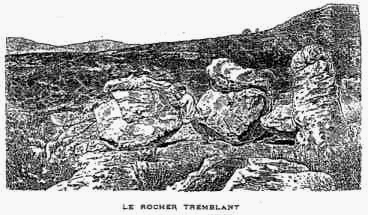
hardly moved at all. The number of inscriptions
engraved upon its face bore witness to the countless number of
tourists who had tested their strength upon it.
A straight path soon led us to the Tiffou
windmill.
We required a few minutes to wash and brush up
before arriving finally at Rennes-les-Bains.
A great many people come here in Summer to
drink the waters or take baths. This chill little place is
instantly transformed into an agreeable and friendly small town.
The bathers had already begun to arrive and tend to their fitness
and we needed to rest our weary limbs and seek refreshment, which
was duly found on the terrace of the Café Cadenat.
But already our coachmen were harnessing horses
to take us to Couiza. Regretfully we left the shady terrace and
hastily made our ablutions with such speed that it was impossible
to judge how modern the conveniences actually were.
To horse! The animals were well rested and keen
to get us back to Couiza at a brisk trot.
Couiza was festive and alive with music all
along the main road under the plane trees.
After a summary repast at M. Igounet’s we
walked to the station, the whistle blew, we were off, gone.
All in all, it had been a lovely day.
E. TISSEYRE.
Bulletin of the Society for Scientific Study
of the Aude, Volume 17 (17th year), pp 98-103 (1906).
priory-of-sion.com
|