New Book About Jesus and Mary Magdalene
In The Razès....
6 July 2026
Updated 8 July 2026
Among normal everyday people, there is no such thing in existence.
The Ongoing Project: “Jésus et le Razès”.
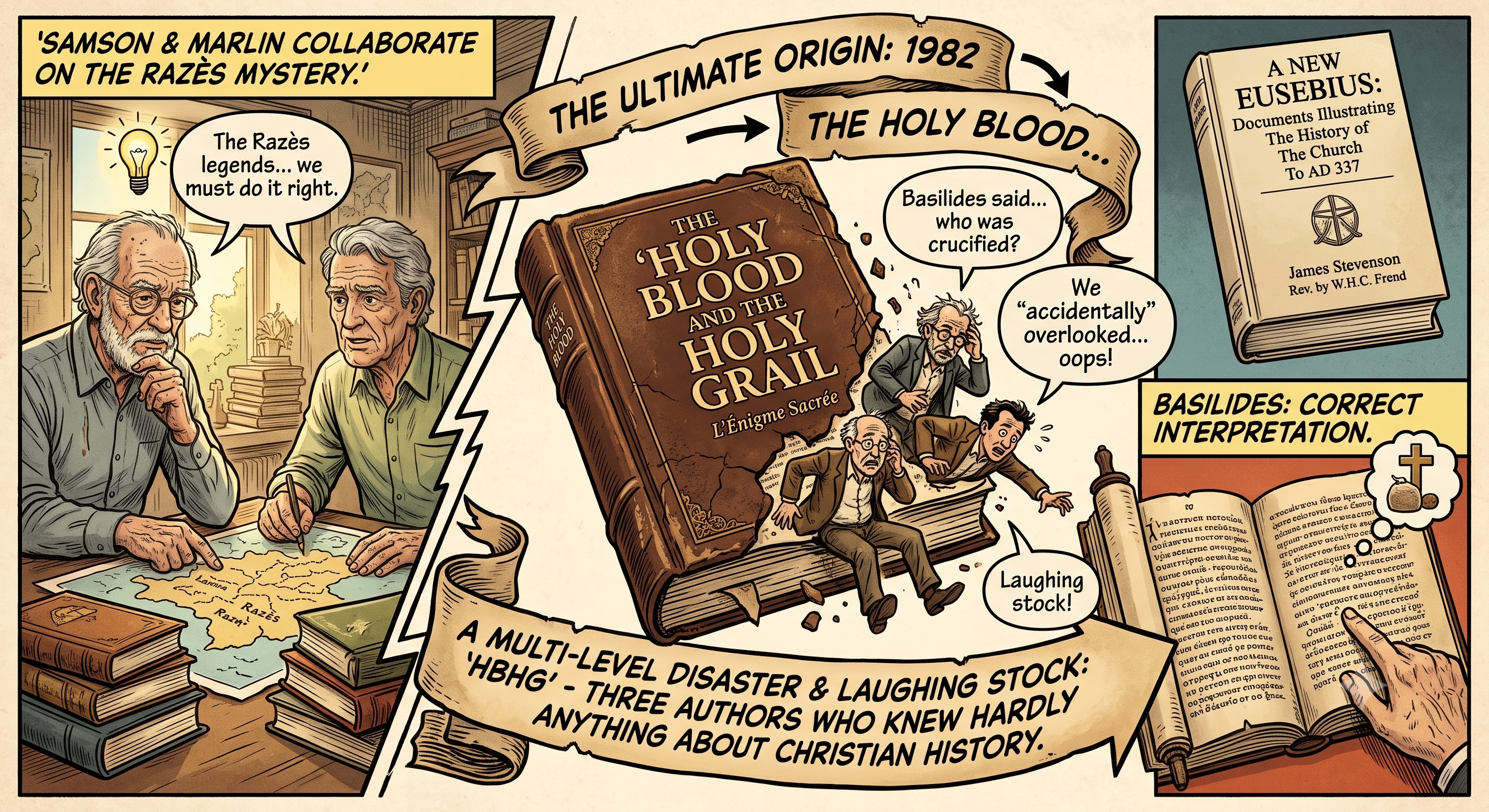
Charly Samson and Philippe Marlin are collaborating on a new book that deals with the mythology and legends surrounding the potential arrival of Jesus and Mary Magdalene in the region of the Razès. The ultimate origin for such a project can only begin with the 1982 publication of “The Holy Blood and the Holy Grail” (French Edition in 1983 called “L'Énigme Sacrée”). There was nothing else in existence before that. The book is a disaster on various different levels and is a laughing stock – being the product of three authors who hardly knew anything about the history of Christianity. For one example, Basilides did not say that Jesus wasn't crucified on the Cross because his place was taken by someone else, but rather because Basilides was a member of a Christian sect that denied the physical substance of Christ. The authors “accidentally” overlooked this basic fact in their book. Instead, the three authors went on to accept the integrity of scholars such as Robert Eisenman in their 1986 sequel “The Messianic Legacy”. Anyway, the details about the correct interpretation of Basilides can be found in the book “A New Eusebius: Documents Illustrating The History of The Church To AD 337”, by James Stevenson (1957), Revised by W.H.C. Frend (1987). Many Editions abound, take your pick which one you want to choose to read.
About Dr Louis-Sophrone Fugairon (real name, Dr Jean-Baptiste), he was one of the three founders of the Gnostic Catholic Church (Ecclesia Gnostica Catholica) who wrote about an “Ordinary Joe” of a Jesus Christ in the review “L'Initiation” , pages 235-245; June 1897 – it was because of this early 20th century form of overall French Gnosticism that gave birth to the false idea that Jesus Christ was a mortal prophet like any other, and cannot be justified with the factual beliefs of the ancient Gnostics nor with the Medieval Dualists like the Cathars, who denied the physical substance of Jesus Christ. This is what was responsible for confusing Baigent, Leigh and Lincoln in the 1982 “The Holy Blood and the Holy Grail”. Another French author was the socialist-atheist Louis Martin (Léon Aubry), who wrote “Les Évangiles Sans Dieu” in 1886. It referred again to an “Ordinary Joe” of a Jesus Christ who survived the crucifixion, who was married to Mary Magdalene with the child Maximin – suitably reflecting the author’s own personal atheism. Neither Louis-Sophrone Fugairon nor the socialist-politician Louis Martin were known about to the authors of “The Holy Blood and the Holy Grail” when it was first published in 1982.
The real questions that we need to ask ourselves is how much do our two French Parapsychologists know about Christianity – and much more to the point, how much do they really know about Bérenger Saunière? Quote: “Obviously, he found a few trinkets left behind by priests or by the bishopric of Alet who had hidden some jewels because of the French Revolution and the threats posed by the Republic” (YAWN).
Below is a “translation” from French into English of the portion of the video on YouTube that mentions the Jesus Book (done by Gemini AI). BTW, Charly Samson is 98 years old, while Philippe Marlin is 79 years old.
21:17 | The Myth of Rennes-le-Château and the New Book: Jesus and the Razès
Host: Okay. Well, in any case, maybe the real treasure of Rennes-le-Château is right there – the archives of Jimmy Guieu. Let's get back to this treasure of Rennes-le-Château, by the way. Have you two done field investigations together, you and Charly?
Philippe: Field investigations? No. Not really. As far as I'm concerned, I've never considered myself a treasure hunter. I am more of a student of mythology. What interests me is how a story like this could take on such proportions. In fact, I wrote a small book that I am currently updating, called “The Two Lives of Bérenger”, because Bérenger Saunière had two lives: a life like everyone else while he was alive – and he died in 1917 –
and then a second life, which is the entire fabrication of the beautiful legend that began to develop starting in the 1950s, when poor Saunière was already far away in the cosmos.
And that's what's interesting, because when you look at Rennes-le-Château coldly from a distance, originally it should have just been a local news item, like many others in France, known only to a few scholars. Instead, it became a global myth. That's what is interesting to analyze. The treasure itself is another matter. Obviously, he engaged in trafficking masses. Obviously, he found a few trinkets left behind by priests or by the bishopric of Alet who had hidden some jewels because of the French Revolution and the threats posed by the Republic. But the treasure of the Visigoths, of Blanche of Castile or whatever – that's another story.
And besides, in all these stories of Saunière's discoveries, there is a characteristic point: everything people talk about, no one has ever seen an original in real life, right? We talk about mysterious parchments. OK, but having said that, they are reproductions; each time the original has disappeared, been burned, or whatever. In short, we can see there is a remarkable scheme that was set up by Plantard and de Sède to create a big buzz, the full motivations of which we still don't completely understand today – meaning, why manufacture all this? There you go. That's what I can say about the Château.
Host: No, it’s very interesting. Charly, is your vision similar or –
Charly: Oh, of course. Yes, we are pretty much aligned. I also took a big interest in all the legends that could have birthed this. It goes back a long way. Yes. And among the legends, there is one for example that interested Philippe and me. Many legends indicate that in the Razès, meaning in the region of Rennes-le-Château, there is the tomb of... you know who.
Host: Yes.
Philippe: Er, yes, I could hear on the speaker that you started talking about Jesus and the Razès.
Host: Yes.
Philippe: And indeed, that is a project of Charly's that I am working on with him. The project is well advanced. No, it won't be finished by the end of this month, because here we are at the end of the month. Right now, I am working on the iconography. [Clears throat] But it’s a subject that I handle the same way Charly does: we don't sell certainty. Moreover, we have absolutely no proof of any kind that Jesus Christ ever came to the Razès. But still, by studying mythologies, it is interesting to question why such an idea could be born and develop through multiple books.
Obviously, the first thunderbolt was “The Holy Blood and the Holy Grail” by Lincoln, Baigent, and Leigh, doubled twenty years later by Dan Brown's “The Da Vinci Code”. All of this forms a rather fascinating mythological whole that we are working on with Charly, trying to trace the path back – starting from Jesus, his teachings, his time in Egypt, perhaps (but with a question mark) his time in India, his final teachings, the Last Supper, his death... Did he die a permanent death or did he survive his resurrection? Is his resurrection a parapsychological phenomenon, and did he eventually flee to Gaul, finding a possible refuge in the Razès?
All of this is paired with parallel legends concerning Mary Magdalene, who is also said to be Christ's companion according to the Gospel of Philip, and who also left Palestine. So it's the Saintes-Maries-de-la-Mer, but it's also and above all the Sainte-Baume and Mary Magdalene's cave at Saint-Maximin, the Sainte-Baume. So we are busy mixing all of that together.
That makes up the first big part. And the second big part is all those who have written on the subject – analyzing how this thesis of Jesus coming to the Razès, complemented by Mary Magdalene, developed. The first traces we found are in the 1800s, in the 19th century, around the 1850s, in the journal “L'Initiation”, where a doctor named Dr. Fugairon was one of the first to put forward the idea that Jesus Christ had taken refuge in the region of Rennes-le-Château. Okay. That's a bit of it.
So it's a huge file on which entire libraries of books exist – tons of books. It’s a huge subject where people say just about anything, and it’s a subject where you have to be careful not to mistake your wishes for reality, but to ask the right questions and wonder what's genuine and what isn't.
That's on the intellectual and formal level. It’s a very, very big job given the state of health of our friend Charly. Since we do all the work by phone, transcribing phone recordings. Then I asked Samantha – Samantha is my Artificial Intelligence that I trained on everything we make – I asked Samantha to sort all of that out for me and make it presentable. After that, I had to move on to the actual writing – meaning shaping it into subject-verb-object sentences, things that hold up. And right now, I am working on... I've done about two-thirds of the iconography, because I want it to be an illustrated book, and with illustrations you don't find just anywhere. Because there are tons of iconographies on the subject, but I'll try to find things that are a bit different. So that's a bit about Jesus and the Razès.
32:46 | Charly's Incredible Memory & Book Release Predictions
Host: Yeah. Yeah. Yes, because indeed, this story of Jesus in the Razès is also the other side, the other mystery of Rennes-le-Château. Because we talk about the treasure in hard cash, but the other theory was the Vatican secret, according to which Jesus would have arrived in Gaul. So that’s one of the secondary treasures of Rennes-le-Château. And as you explained, this work is all done by phone because our listeners know that Charly has AMD (Age-related Macular Degeneration), so he can no longer work on a computer. So Charly, you have everything in your head, and that’s what’s incredible. How do you manage to formalize and think through all of this?
Charly: Oh, because these are subjects that fascinated me so much that they are truly engraved on my hard drive, you see! [Laughs]
Host: In your internal hard drive!
Charly: In my hard drive.
Host: Right. And did these phone exchanges take you a long time to build the foundation that Philippe is working on now? When did you start?
Charly: That's a good question. We started about six months ago.
Host: Okay. So on one hand it's quite fast, but on the other hand, it's also a massive amount of work. And as you explained, there is still all this iconographic work to put in place. Do you have a forecast for the release of the book?
Philippe: For me, by the end of the year would be good.
Host: Okay, so we're looking more towards Christmas 2026, so people can put it at the foot of their Christmas tree. In any case, it sounds like and risks being a reference work, and I certainly get that feeling given the work that has been done and that you are doing. We will follow this very closely throughout these shows.
Now, another work you did together, which is already out – well, that you took over and reworked, and which came out last year – is “La Momie de Venise”. How did you come to work on this subject?
Philippe: How did I come to it? I think it’s rather up to Charly to answer. How should I put it... Charly had done this book with a small publishing house, very pleasant by the way, but they had trouble distributing the work. So we took it over, remastered it a bit, gave it a new cover, and highlighted what lies behind “La Momie de Venise” – which is the blood cult, you know? That’s what’s interesting. There you go.
Host: The blood cult, the quest for immortality.
Philippe: The quest for immortality. The questions humanity constantly asks itself, and “La Momie de Venise” is basically the pretext to then tackle these other subjects. That’s it. Exactly.
Host: Exactly. So that one, friends, you have direct access to it either at the Rennes-le-Château shop, or I saw it on Amazon.
Philippe: Yeah, that’s it. Yeah, it’s on Amazon. You can find it easily.
Host: Yes, with a truly beautiful cover. I have the edition by Stéphanie Del Reg, and both editions are completely beautiful. We’ll talk about the subject again in the coming weeks, friends, because last year we already recorded a full show on “La Momie de Venise” with Charly. So for the moment, it’s still packed away, but it will come online this summer.
|