Eugène Vintras, J-K Huysmans, Là-Bas – Some Notes
20 February 2026
Revised 22 February 2026
Whilst the historical figure of Eugène Vintras had nothing at all to do with either the Gnostic Catholic Church or the Priory of Sion, some of the following notes may be of interest.
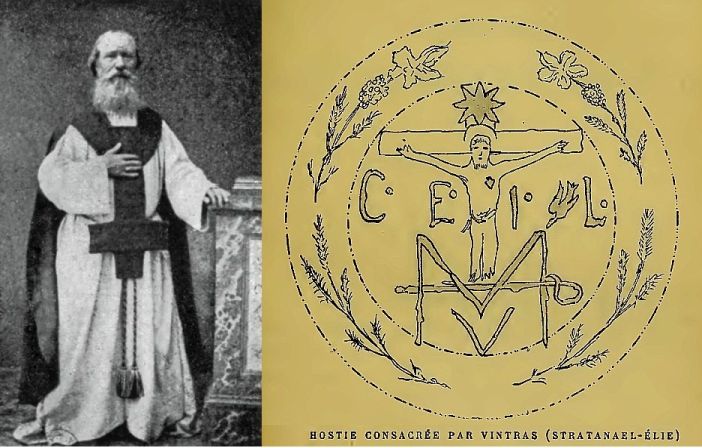
Joris-Karl Huysmans (1848-1907) was a French novelist who published “Là-bas” (Tresse & Stock, Paris, 1891). This novel dealt with the subject matter of Satanism in late contemporary 19th century France. The novel’s main character was known only by his surname Durtal, who was researching the Black Mass, one of the character’s names was Dr Johannès, that some people identified with Joseph-Antoine Boullan, but others identified with Eugène Vintras (following the death of Vintras, Boullan became the leader of his sect). Followers are deeply involved in the occult and anti-Christian practices. Johannès (Boullan or Vintras, or a combination of the two) is depicted as a benevolent mystic, distinct from other, more nefarious Satanists, but he is still associated with controversial, esoteric rituals. The novel highlights Vintras's use of the inverted cross on his vestments, which he intended to symbolize a new, non-suffering church, but which was interpreted by many as a symbol of anti-Christian, Satanic, or “downward” spirituality. Durtal discovers that Satanism is not simply a thing of the past but is alive in fin de siècle France. He embarks on an investigation of the occult underworld with the help of his lover Madame Chantelouve. The novel culminates with a description of a Black Mass.
Another French author was Jules Bois, a French journalist and occult investigator, who documented Eugène Vintras and his followers in his 1895 book, “Satanism and Magic” (Satanisme et magie), which provided a detailed, albeit sensationalized, account of late 19th-century French occultism. Jules Bois followed the known biography of Eugène Vintras – whose investigation covered the accusations of demonic rituals and sexual excess that surrounded Vintras, including reports of Black Masses and the accusation by followers that Vintras engaged in, or encouraged, sexual misconduct (described in some accounts as “senseless sexual depravations” – allegations that were not followed up on by the Roman Catholic Church of that period).
Jules Bois also highlighted the connection between Vintras and his successor, the defrocked priest Abbé Joseph-Antoine Boullan, who continued to promote Vintras's doctrines and, according to critics, further blended them with “sex magic”. Jules Bois's writings on Vintras were part of a wider, often sensationalist, coverage of “Satanic” sects in France, which was often intertwined with the “Magic Wars” of that era. [1] [2] [3]
During his conviction for fraud inside prison from 1861-1864, Joseph-Antoine Boullan wrote a confession of fourteen pieces of pink paper known as Cahier Rose. It subsequently passed into the hands of Huysmans and is now in the Vatican Library. Fragments have been published. Quoting Father Bruno des Jesus-Marie: “The life of the instincts predominated in him at certain times, and arrested his affective development by diverting it into an erotic scatology of a childish variety, which was in marked contrast with his intelligence” and, “We did not think fit to publish the full text of the Confession of Boullan. The reader will pardon the omission, when we assure him that he could not have stomached the reading of it. Apart from the interesting points we have noted, it would merely occasion disgust and even boredom. It is more fitting to keep such matter within bounds, and even when one does so, one still runs the risk of offending sensitive readers” (“Satan,” Edited by Father Bruno des Jesus-Marie, pages 264 & 267, Sheed & Ward, New York, 1952; also published as a paperback entitled “Satan: The Tempter’s Existence In The World And Nature,” Sophia Institute Press, 2024; translated from the original, P. Bruno de J.-M., “La Confession de Boullan,” Études Carmélitaines, Paris: Desclée de Brouwer, 1948, special issue on Satan).
Quoting Robert Pincus-Witten: “We know from the confession that Boullan attributed miraculous powers to consecrated hosts mixed with human excrement, and that at the conclusion of a Black Mass of 8th December, 1860, Boullan sacrificed at the altar, the child to which Adèle Chevalier had just given birth. These crimes became known only after Boullan's death” (Robert Pincus-Witten, “Occult Symbolism In France: Joséphin Péladan and The Salons de la Rose-Croix,” pages 60-61, Garland Publishing, New York & London, 1976).
|