Timeline – The Pentagram & Rennes-le-Château
05.10.2026
1972
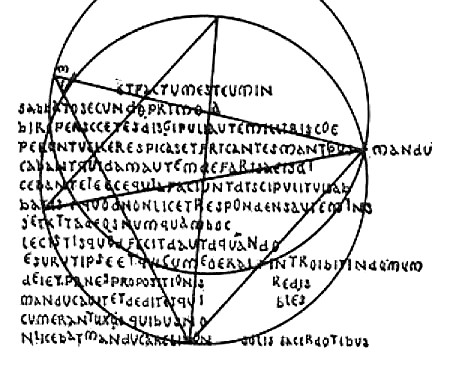
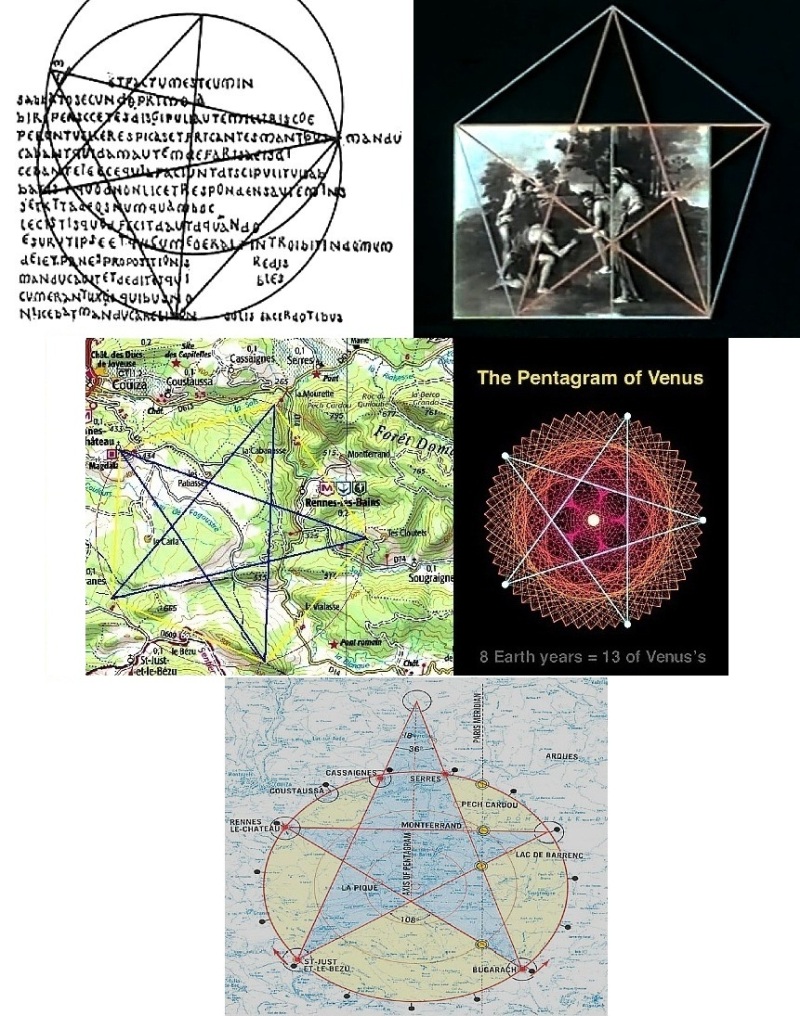
The Small Parchment, according to Henry Lincoln's personal analysis, contained the geometric pattern of a Pentagram (“The Lost Treasure of Jerusalem”, Chronicle, BBC 2, 31 March 1972).
1974
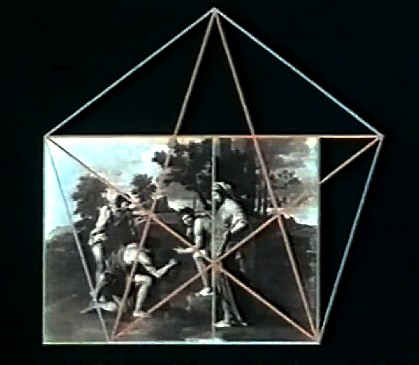
According to Professor Christopher Cornford, who at that time was at the Royal College of Art between 1962 and 1979, commented that the painting “Les Bergers d'Arcadie”, by the artist Nicolas Poussin in around 1638, hanging in the Musée du Louvre in Paris, contained the dimensions and proportions of a Pentagram, and he suggested that the shape of the Pentagram should be looked for in the landscape of Rennes-le-Château (“The Priest, The Painter And The Devil”, Chronicle, BBC 2, 30 October 1972; repeated on 20 November 1979).
1979
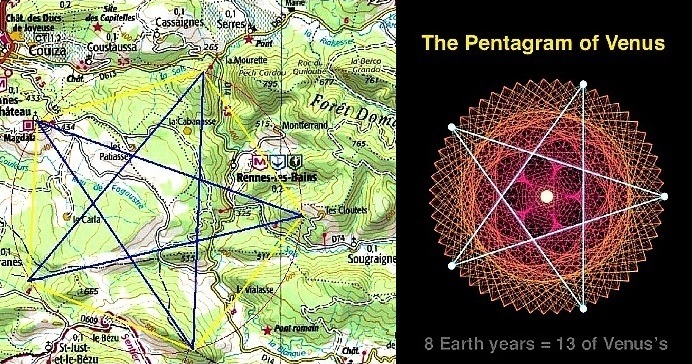
Henry Lincoln claimed that there were five peaks located at Rennes-le-Château that nearly formed a perfect Pentagram, only one of its peaks did not quite match the dimensions and proportions. Henry Lincoln wanted to use the “Jesus Bloodline” as the solution of Rennes-le-Château, but was rejected by the producer of the documentary. Instead the writer on the esoteric, Fred Gettings, was invited to contribute a different ending, proposing that the solution lay in the ancient beliefs of the Planet Venus (“The Shadow of The Templars”, Chronicle, BBC 2, 27 November 1979).
1985
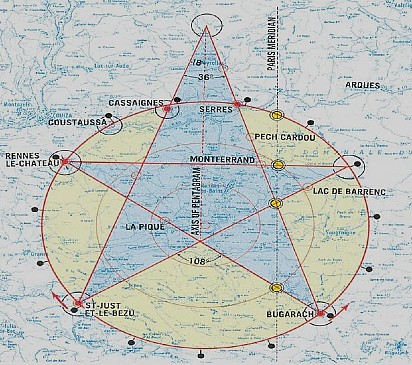
David Wood's book “Genisis: The First Book of Revelations,” with its claim of a Pentagram of irregular proportions in the landscape of Rennes-le-Château. This was followed-up on in the book by David Wood and Ian Campbell, “Geneset: Target Earth” (1994).
1991 & 1997
Henry Lincoln's two books “The Holy Place: Saunière and the Decoding of the Mystery of Rennes-le-Château” (1991) and “Key to the Sacred Pattern”, elaborating on his theories concerning The Pentagram & Rennes-le-Château.
|