Eugène Vintras, 1807-1875
17 February 2026
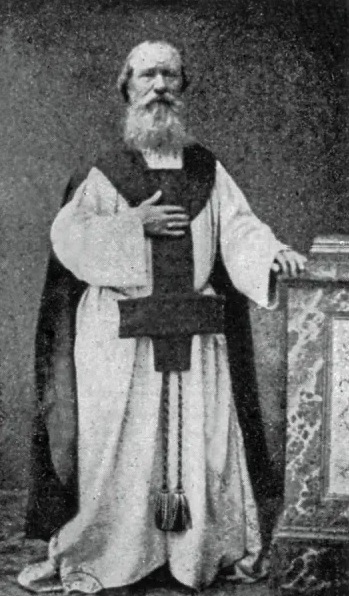
Eugène Vintras was a 19th-century French mystic who founded a controversial movement called “Œuvre de la Miséricorde” (Work of Mercy). Vintras claimed to receive divine visions of the prophet Elijah and alleged that “bloody” hearts appeared on consecrated hosts. Vintras declared himself a prophet for a new era (the reign of the Holy Spirit), calling himself “l’Organe”. His followers, organized in “septaines” (groups of seven), believed they were fighting a spiritual war, using these hosts for protection.
In 1839, Vintras began a job in a factory where he started a partnership with Ferdinand Geoffroy, who had from 1833 been the agent of Karl Wilhelm Naundorff, the self-styled pretender to the Throne of France, the surviving son of King Louis XVI and Marie Antoinette (however, DNA tests conducted in 1993, 1998, and 2004 compared mitochondrial DNA from Naundorff’s remains against hair samples from Marie-Antoinette and her relatives. The tests conclusively ruled out any biological connection between Naundorff and the Bourbon family, proving he was not the Dauphin). Geoffroy had frequented mystico-political circles in which were transmitted for more than 50 years heavenly revelations.
It was in November 1839 that Vintras had received messages from the Archangel Michael, then the Virgin Mary, Saint Joseph, and he later claimed to be the reincarnation of the prophet Elijah. It is also believed that it was in 1839 that Vintras believed he received a letter from the French Monarchist sect “Saviours of Louis XVII” (Savveurs de Louis XVII), this letter recognized Vintras as a divinely chosen prophet, ushering in a new spiritual era for France.
Eugène Vintras called himself “l’Organe” and with the protection of talismans he began to distribute, would provide Escape from Disaster. This catastrophe would be the prelude to the Reign of the Paraclete, the Reign of Love.
Vintras’s activities were denounced by the Catholic Church as heretical and diabolical. Pope Gregory XVI formally condemned his movement on 8 November 1843 in his Papal Letter “Ubi Primum”.
Vintras was imprisoned for five years for fraud and later continued his, largely discredited, activities in England. He died in 1875 at the age of 67.
Following the death of Eugène Vintras, his name was later (mis)appropriated by the later Gnostic Catholic Church (Église Gnostique Catholique) as well as several notable occultists of the 19th century. For example Éliphas Lévi
(who later distanced himself from Vintras, denouncing him as a false prophet, claiming that his movement “Œuvre de la Miséricorde” bordered on the diabolical (found in A. E. Waite, “The Mysteries of Magic: A Digest of the Writings of Eliphas Lévi” [1886]; a compilation and translation of various works by Lévi, primarily drawing from his French publications).
A. E. Waite himself considered Vintras to be a complex and enigmatic figure, and included him in his broader analysis of Mystical Messianism in France, in his book, “The Holy Grail: Its Legends and Symbolism” (1933).
Stanislas de Guaita suggested that the bloody hosts (later also adopted by Joseph-Antoine Boullan) were “true, but they are demonic” (Stanislas de Guaita, “Les hosties sanglantes sont vraies, mais elles sont démoniaques!”, in “La Clef de la Magie Noir: Essais de Sciences Maudites II” (Chamuel – Bibliothèque Chacornac, 1897).
It's obvious from this very short biography and abbreviated description of Vintras how today's cheapjack esoterics would base their theories on him – also not forgetting the spicy book by Jules Bois, “Le Satanisme et la Magie” (1895).
Has the recent interest in Eugène Vintras been inspired by the novel “La Colline Inspirée” by Maurice Barres? (Émile-Paul Frères, Paris, 1913), that features him? The Basilica of Our Lady of Sion (Notre-Dame de Sion) is a historic centre of Marian devotion located in the Saintois region of Lorraine, France, specifically on the hill of Sion-Vaudémont in the town of Saxon-Sion. It is one of the most prominent pilgrimage sites in the region. It is known for devotion to “Our Lady of Sion”.
The simplest solution is always the best – Eugène Vintras operated outside the official Roman Catholic Church. He was a leader of a cult. The mainstream view is that he suffered a genuine underlying psychosis, which allowed him to believe himself inspired from above and which led him, more or less consciously, to employ, in order to win the faith of the simple-minded.
Eugène Vintras was not in the least similar to Abbé Bérenger Saunière of Rennes-le-Château – who although he was divested of his official priestly duties in 1911 – was at least a Traditional Roman Catholic Priest whose only fault lay in his wealth-creation of trafficking in masses.
|