“Le Serpent Rouge” Explained!
21 September 2025
Updated 29 September 2025
We can all write 4,322 words about the 1967 poem “Le Serpent Rouge” that is falsely attributed to three innocent authors and is totally meaningless – it is without any point except to meander and to traipse devoid of any direction.
It can be perfectly demonstrated by the contents of the correspondence dating from the 1960s between Pierre Plantard, Philippe de Chérisey and Gérard de Sède was to confuse, bewilder and baffle the reader – and this was the whole point of the myth of the Priory of Sion – not to stay in any fixed one direction, but to be an elastic variety of different elements designed to confuse the gullible so they try to interpret and try to make sense of it all. The protagonists of the correspondence, the Priory Documents and authors of various books were of course all laughing their heads off. Their ambitions had become realised!
It has been stated before that the said correspondence cannot be reproduced because copyright belongs to Thomas Plantard de Saint Clair, Gaspard de Chérisey and Arnaud de Sède (the sons of the three authors) – although of course the correspondence may be accessed by chosen individuals in private.
Such is the waste of time called the poem “Le Serpent Rouge”. But it was more than a perfect invention for the gullible.
Is there anything really original in the poem “Le Serpent Rouge”? Philippe de Chérisey seemed to have got his idea for using the constellation of Ophiuchus in the Zodiac from the noted astronomer of Bourges Observatory, Abbé Théophilus Moreux (1867-1954). Abbé Moreux used the 13th constellation of Ophiuchus in his version of the Zodiac in Les Influences Astrales (G. Doin et Cie Editeurs à Paris, pages 48-49, 1943).
Pierre Plantard himself referred to Ophiuchus in the 1959 and 1960 issues of the journal “Circuit”, once making reference to Théophilus Moreux [Reference 1], and then also to Camille Flammarion (1842-1925) [Reference 2], who also believed that the Zodiac contained Ophiuchus, although not in the astrological context, but in the astronomical context. Plantard mentioned specifically Flammarion’s diagram of the Zodiac in its 13 Zones in “Annuaire Astronomique”, 1959, page 85 – Plantard fashioned his tone in his usual and inevitable style of esotericism.
Here is the scan from page 85 of “Annuaire Astronomique”, November 1959; as referenced by “Chiren” (Pierre Plantard) in Circuit, Number 5, page 1 [Reference 2], we can only assume that he got the page number wrong.
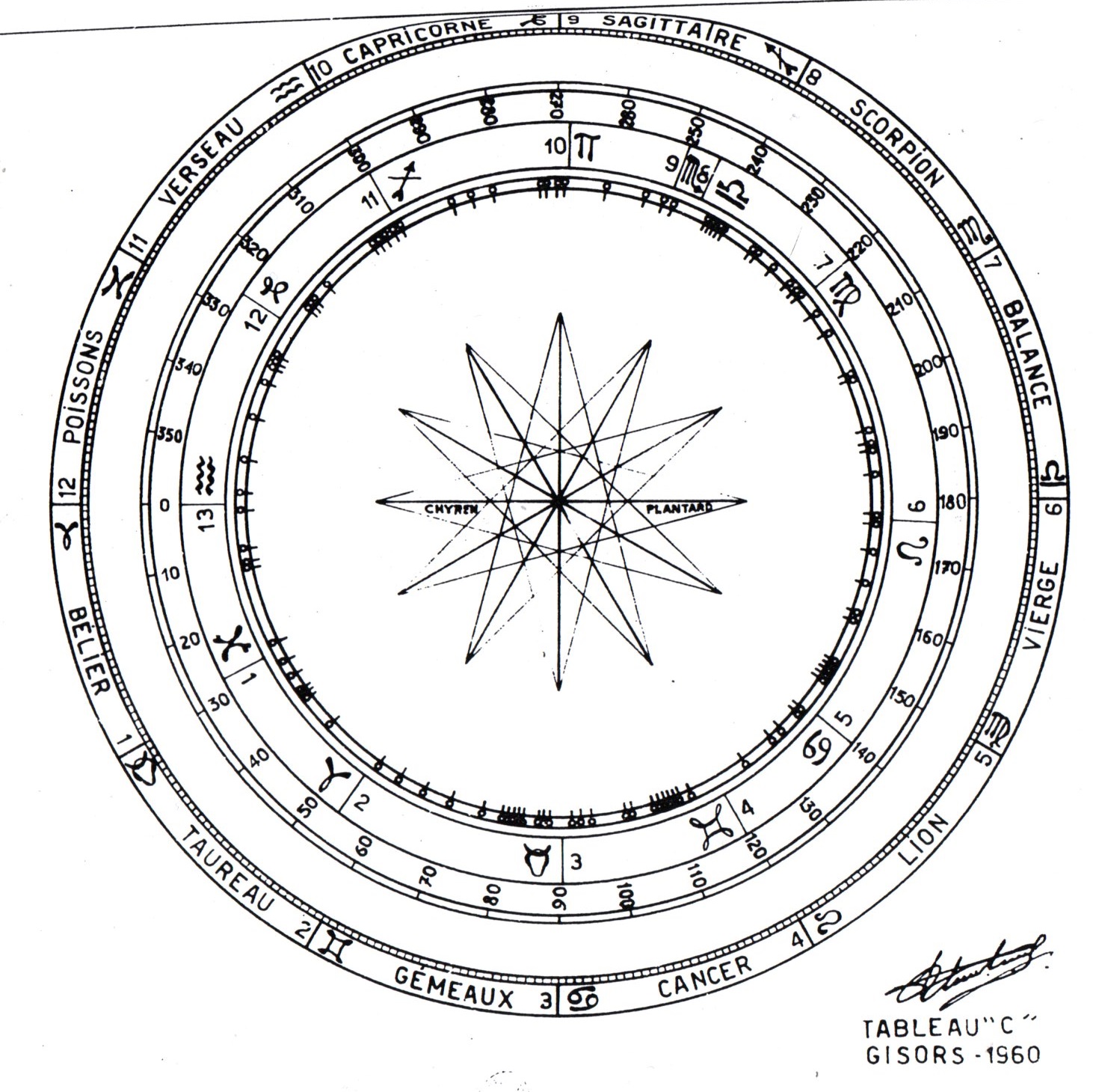
Let’s not forget Pierre Plantard’s Zodiac contained in “Gisors et son secret” that crucially contained Ophiuchus as one of the main ingredients for the unfolding of his political vision (that became stifled on 1 July 1962, when Algeria voted for independence from France).
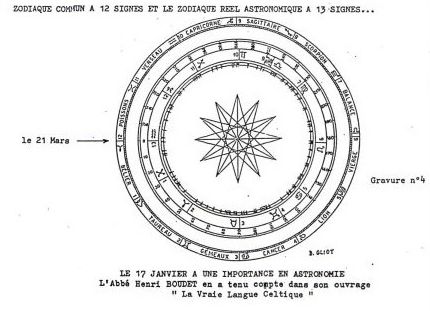
Stephen Schmidt (born 1927) seems to have been the first modern popular author to have used Ophiuchus (December 6 to December 31) among his 14 sign system of the Zodiac – also adding the sign Cetus (May 12 to June 6) in his book, Astrology 14: Your New Sun Sign. The Most Exciting Discovery In Astrology In Two Thousand Years! (Bobbs-Merrill, 1970); also featured in a book review in a Time magazine article (Volume 96, Number 21, page 44, 23 November 1970). Astrologers were to reject the use of Ophiuchus and Cetus by Schmidt in their mainstream 12-sign Zodiac. In 1977 Dr Lee T. Shapiro had his article published, “The Real Constellations of the Zodiac” (Planetarian, Volume 6, Number 1, pages 17-18, 1977). In fact, the constellation of Ophiuchus of the Zodiac had been known about since at least the Babylonians around 3,000 years ago, but they decided against using it since they aligned their 12-month period with the Lunar Calendar. It looks like neither Stephen Schmidt nor Dr Lee T. Shapiro had ever heard of Abbé Théophilus Moreux or Camille Flammarion – or Gabriel Trarieux d'Egmont (1870-1940), who also strongly alluded to the constellation Ophiuchus, without actually mentioning it by name in the quote given by “Chyren” in Circuit, Number 6, page 1 (December 1959).
However, the big problem with the poem “Le Serpent Rouge” is that the Paris Meridian does not pass through the church of Saint Sulpice. What the sun’s rays represent when they reach the gnomon is something that Pierre Plantard and Philippe de Chérisey didn’t want to tell us (in actual fact, the Paris Meridian is located some 100 meters west of the church of Saint Sulpice).
Of course, everyone has the right to believe in anything they wish, however illogical – so long as the right to be sceptical and to put things to the critical test also has the right to exist.
Of course the Rennes-le-Château conspiracy theories are a terrible addiction with the Believers needing to constantly update them and to introduce new elements into them, in order to keep this game going. Noël Corbu let the genie out of the bottle during the mid-1950s and now we are stuck with it forever, no matter what.
|