Mary Magdalene Lives On In Rennes-le-Château Lore
3 July 2026
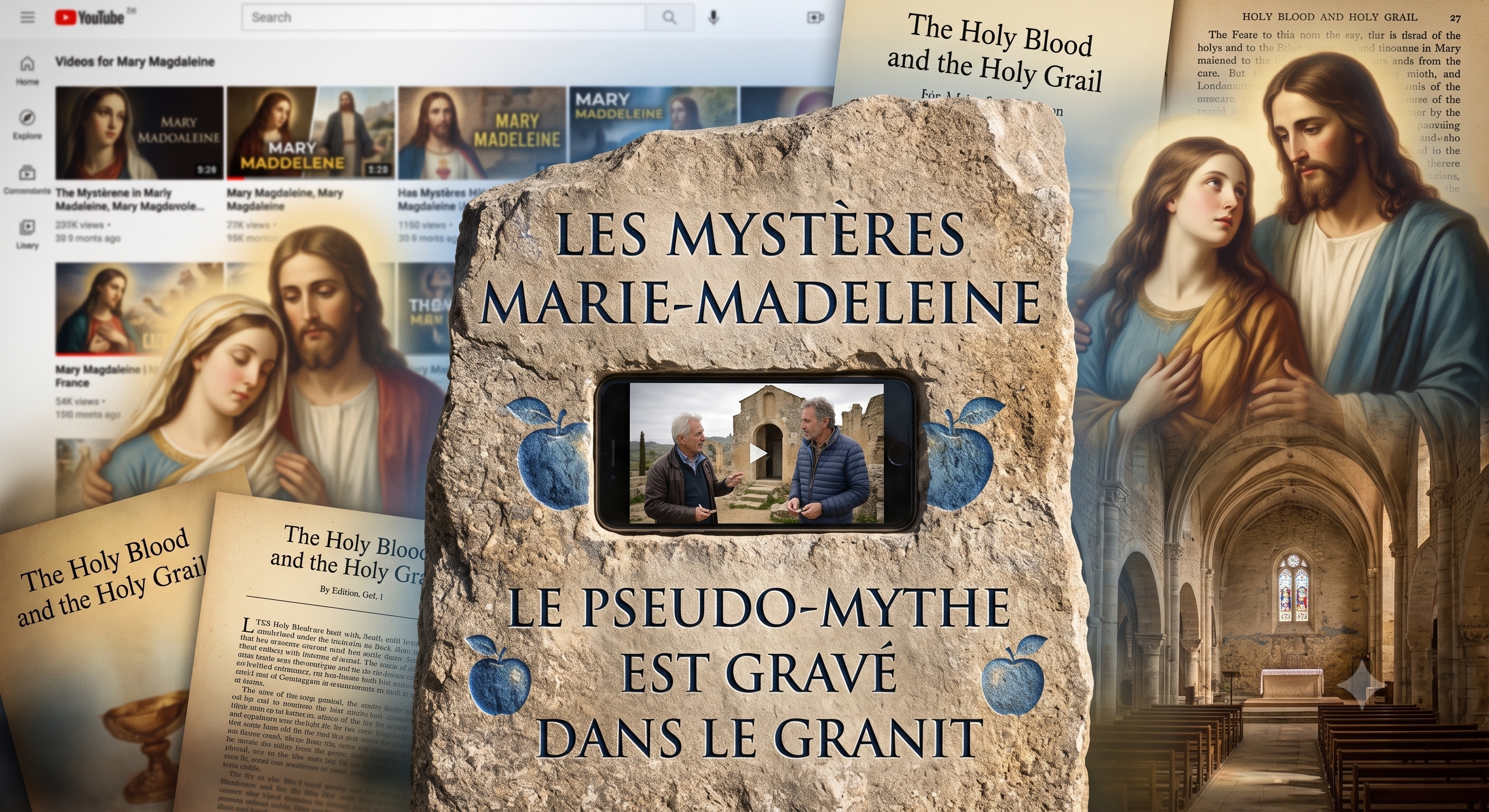
Christian Doumergue and David Galley are bringing out a documentary on Mary Magdalene. The inspiration of “The Holy Blood and the Holy Grail” continues to live on – just like Philippe de Chérisey's 1964 creation of “Blue Apples”. The Pseudo-Myth has become carved into granite! YouTube entries abound. The promo-clip called “Les Mystères Marie-Madeleine” can be found on Christian Doumergue's Facebook.
Just to make it clear – Mary Magdalene is not referred to at all by the Christianity of the First Century. There was no such thing as the “historical Incarnation” within Christianity until the mid-Second Century, when the Gospels made their first appearance. The historical accounts were the later products of the second century and nobody can prove otherwise.
From the Second Century it became the Core Requirement of Christian Faith to view the Gospels as historical documents. No such requirement existed during the First Century – not one Christian from that period of time alludes to it or mentioned any “historical material” found in the Gospels. Of course, Fundamentalist Christians and the believers in “The Holy Blood and the Holy Grail” are both equally united in their respective Faiths in the historicity of the Gospels – except that the Fundamentalist Christian believes in a Divine Miracle Worker – while the “Holy Blood, Holy Grail” believers put their faith in an “Ordinary Joe” who was just another human without supernatural powers, and who did not rise from the dead – and also, by the way – was without any historical or mythological pedigree whatsoever in ancient Christian texts – until “The Holy Blood and the Holy Grail” was published in 1982 – and revised Gnosticism and Catharism as being the direct opposites of what those cults really were.
One religious interpretation of what Jesus Christ and Mary Magdalene is that they were the direct opposites of Adam and Eve – whereas the latter pair were responsible for losing their Paradise of Garden of Eden and falling into Sin, Jesus Christ and Mary Magdalene represented the direct opposite – reclaiming Paradise and the Garden of Eden through sexual celibacy. Alternatively, Mainstream Christianity does not teach that Jesus and Mary Magdalene were a celibate pair reversing Eden. Instead, traditional theology views Jesus as the “Last Adam” who reverses the Fall through his obedience and sacrifice, often pairing him with Mary as the “New Eve” or recognizing Mary the mother of Jesus in that role. In either case, the “historical fact” rather reflects the personification of myth involving redemption and salvation.
It should also be remembered that the sacrament predated the existence of The Gospels and the resulting belief in a “Historical Jesus Christ” – unless, of course it can be proved otherwise by the discovery of papyrus texts dating from the First Century, which seems highly unlikely.
The sheer addiction to the Gospels is a marvel to behold – how humanity has fallen victim and succumbed to this nonsense – either in believing the traditional miracle worker or in the “Ordinary Joe” version of Jesus Christ, with Mary Magdalene often depicted as his concubine in the latter version.
Finally, it’s rather amusing to think how Abbé Saunière would have reacted to his village of Rennes-le-Château being turned into such a lunatic asylum!
Post Scriptum: You must laugh – Jesus Christ as an “Ordinary Joe” – it just misses the point entirely!!
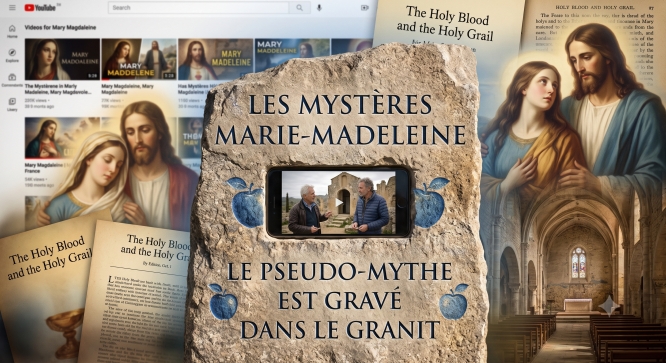
English Transcript of the promo-clip called “Les Mystères Marie-Madeleine” (note the lack of distinction between early traditions of the biography of Mary Magdalene and the much later Medieval traditions all rolled into one!)
(0:00) The Gospel tells us that she is a sinful woman, so we can imagine a sort of fairly free courtesan.
(0:13) She is a woman who is likely a socialite, living in high society, but who is preoccupied with existential, philosophical, and spiritual questions.
(0:19) After her conversion, Mary Magdalene was part of the group of women who followed Christ.
(0:23) She would remain faithful to Jesus all the way to the cross, being with Him at the moment He died on a cross.
(0:31) We will also see her perform a gesture, namely, collecting the blood of Christ.
(0:39) Tradition identifies the cave as the place where she lived in Provence for several years,
(0:46) and what is today the Basilica of Saint-Maximin as being the tomb of Mary Magdalene.
(0:51) So that is where we have the primary relics of Saint Mary Magdalene.
(0:57) We can well imagine that this vial contains a special treasure.
(1:04) You really have to imagine such a miracle happening over two and a half days, visible to everyone.
(1:10) We see that there are also traditions in the region regarding Mary Magdalene's passage.
(1:17) According to certain hypotheses, her tomb is located in Rennes-le-Château.
(1:21) Could he have discovered documents related to the life of Mary Magdalene?
(1:27) Mary Magdalene is everywhere in this church,
(1:29) but when you begin to observe her representations closely,
(1:32) you notice that there are little strange details.
(1:35) He dedicated all his constructions to Mary Magdalene.
(1:38) So, in my opinion, it was not by chance.
(1:40) And if it was intentional, there is a reason for it.
(1:44) Subtitles by Radio-Canada
|